GraphQL vs REST 2026: Which API Strategy Cuts Dev Costs?
Key Takeaways
- The HTTP caching argument against GraphQL is misleading when you examine production implementations
- The N+1 problem exists in both GraphQL and REST, not just GraphQL as commonly claimed
- Facebook built GraphQL for a monolithic PHP backend, not hundreds of microservices as often repeated
According to [WunderGraph's comprehensive fact-check on DEV Community](https://dev.to/wundergraph/graphql-vs-rest-18-claims-fact-checked-with-primary-sources-2026-117l), most commonly repeated claims about GraphQL vs REST turn out to be misleading or incomplete when traced back to their original sources. This analysis matters because your API architecture decision affects development velocity, infrastructure costs, and team productivity for years to come.
Read in Short
18 popular claims about GraphQL and REST were traced to primary sources. Result: many accepted truths are wrong. The HTTP caching argument against GraphQL is misleading. The N+1 problem affects both technologies. Facebook never built GraphQL for 'hundreds of microservices.' Before picking an API strategy, check the evidence, not the blog posts.
Why GraphQL vs REST Matters for Your Bottom Line
Your API architecture isn't just a technical decision. It's a cost center that compounds over time. The wrong choice means slower feature development, higher infrastructure bills, and frustrated engineering teams. The right choice accelerates product velocity and reduces operational overhead.
But here's the problem: most advice about GraphQL vs REST comes from vendors, advocates, or developers with strong opinions and weak evidence. When WunderGraph's team traced 18 common claims back to their original sources, they found that even widely repeated assertions crumble under scrutiny.
The Facebook Origin Story: What Actually Happened
You've probably heard that Facebook built GraphQL to unify hundreds of internal microservices. It's repeated in conference talks, blog posts, and vendor pitches. There's just one problem: it's not true.
“Meta (formerly Facebook), where GraphQL was created, has continued to use a monolithic GraphQL API since 2012.”
— GraphQL Foundation
The real story: Facebook built GraphQL in 2012 for their iOS News Feed. The problem wasn't microservices coordination. It was mobile bandwidth constraints and the limitations of REST for mobile clients that needed precise data fetching. Facebook ran a massive PHP codebase, scaled through HipHop (a PHP-to-C++ transpiler) and later HHVM.
What This Means for Your Architecture
If you're evaluating GraphQL because you have microservices complexity, that's valid. But don't assume Facebook's use case matches yours. They solved a mobile data-fetching problem, not a backend coordination problem. Know which problem you're actually solving before choosing your tool.
Is GraphQL Bad for HTTP Caching? The Evidence Says Otherwise
This is the most common argument against GraphQL in enterprise settings. CTOs hear it in architecture reviews. It shows up in RFP responses. And it's misleading at best.
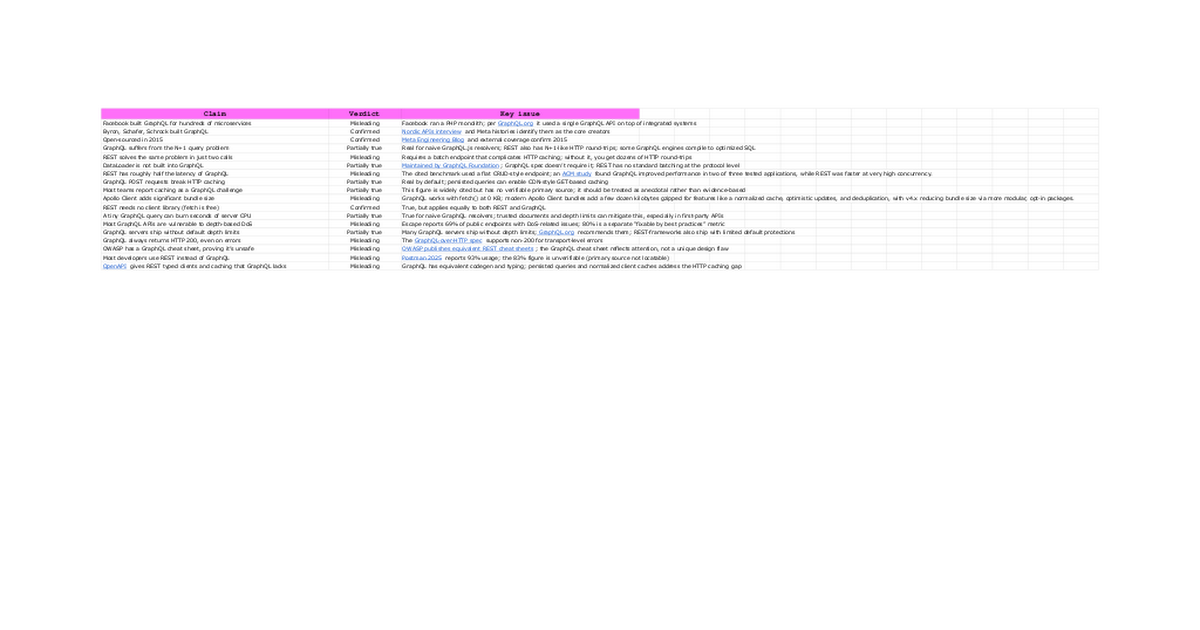
The claim assumes you're comparing default REST (which uses HTTP caching out of the box) with default GraphQL (which typically uses POST requests that bypass standard HTTP caching). But nobody runs production systems on defaults.
| Scenario | REST | GraphQL |
|---|---|---|
| Default HTTP caching | Built-in via GET | Requires configuration |
| Production caching | CDN + application cache | CDN + persisted queries + application cache |
| Cache invalidation complexity | Moderate | Higher but manageable |
| Edge caching capability | Standard | Available with modern tooling |
When you compare production implementations, GraphQL caching is different but not inherently worse. Companies like Shopify, GitHub, and Stripe run GraphQL at scale with effective caching strategies. The question isn't whether GraphQL can cache. It's whether your team has the expertise to implement it properly.
The N+1 Problem: Does REST Actually Avoid It?
The N+1 query problem is real. Your server makes one query to fetch a list, then N additional queries to fetch related data for each item. It kills performance and inflates database costs.
GraphQL critics point to this as a fundamental flaw. But here's what the fact-check reveals: REST has the exact same problem. Multiple high-profile sources confirm that any API that allows fetching related resources can trigger N+1 queries if not handled properly.
GraphQL has DataLoader. REST has eager loading patterns. Both require developer awareness and proper implementation. Blaming GraphQL for N+1 problems is like blaming a hammer for hitting your thumb. The tool isn't the problem. The implementation is.
Understanding API architecture decisions requires solid software design principles
How Should CTOs Evaluate GraphQL vs REST?
Forget the tribal debates. Here's a framework based on what the evidence actually supports:
- Identify your actual constraints: Mobile bandwidth? Team expertise? Existing infrastructure?
- Compare production implementations, not defaults: Ask vendors how their solutions work at scale, not in demos
- Calculate total cost of ownership: Include learning curve, tooling, monitoring, and operational overhead
- Run a proof of concept with your data: Generic benchmarks don't reflect your specific use case

When GraphQL Makes Financial Sense
GraphQL shines in specific scenarios. If your mobile apps are bandwidth-constrained, the ability to request exactly the data you need reduces transfer costs and improves user experience. If you're supporting multiple client types (web, mobile, partner integrations), a single GraphQL endpoint often beats maintaining multiple REST APIs.
✅ Pros
- • Precise data fetching reduces over-fetching on mobile
- • Single endpoint simplifies client development
- • Strong typing catches errors at development time
- • Self-documenting schema improves developer experience
❌ Cons
- • Steeper learning curve for teams new to GraphQL
- • Caching requires more deliberate implementation
- • Query complexity can impact server performance if not managed
- • Tooling ecosystem is smaller than REST
The financial case for GraphQL is strongest when you're building for multiple platforms and your biggest cost is development time, not infrastructure. If your team ships faster with GraphQL's developer experience, that velocity compounds over months and years.
Developer productivity tools that complement your API strategy decisions
When REST Remains the Better Business Choice
REST isn't going anywhere. For simple CRUD operations, public APIs with broad consumer bases, or teams with deep REST expertise, switching to GraphQL may not justify the transition costs. The infrastructure around REST is mature, well-understood, and requires less specialized knowledge.
If your engineering team has five years of REST patterns baked into their muscle memory, the productivity hit during GraphQL adoption might outweigh the long-term benefits. Calculate the transition cost honestly. Include training, refactoring, and the inevitable mistakes during the learning period.
The Hybrid Approach Most Enterprises Actually Use
Here's what the fact-check doesn't tell you explicitly but the evidence supports: most successful enterprises use both. They use GraphQL for client-facing APIs where flexible data fetching matters, and REST for internal service communication where simplicity and caching are priorities.
This isn't a cop-out. It's pragmatic architecture. Your mobile team gets the GraphQL benefits they need. Your backend team keeps the REST patterns they know. The integration layer handles the translation. This approach reduces risk and lets you evaluate GraphQL incrementally rather than betting everything on a migration.
How AI can complement your API strategy for customer-facing applications
Logicity's Take
At Logicity, we've implemented both GraphQL and REST APIs for clients across different scales. Our practical experience aligns with this fact-check: the tribal arguments miss the point. We've built GraphQL APIs for Next.js applications where the frontend team needed flexible data fetching, and we've kept REST for backend integrations where simplicity mattered more than flexibility. For Indian startups especially, the real question isn't which technology is 'better.' It's which one your team can ship faster with. If you're building a mobile-first product with complex data relationships, GraphQL's developer experience often justifies the learning curve. If you're connecting to existing enterprise systems or building simple CRUD interfaces, REST's maturity and tooling wins. The hybrid approach works. We've seen it reduce arguments in architecture reviews and let teams focus on shipping instead of debating. Don't let vendor marketing or conference talks drive your architecture decisions. Run a two-week proof of concept with your actual data and your actual team. That tells you more than any blog post.
Frequently Asked Questions
How much does migrating from REST to GraphQL cost?
Migration costs vary widely based on API complexity and team experience. Expect 2-4 months for a medium-sized API with a team learning GraphQL for the first time. Factor in training costs (typically $5,000-15,000 for a team), tooling setup, and the productivity dip during transition. Many companies report breaking even on the investment within 6-12 months through faster feature development.
Is GraphQL worth the investment for a startup?
For mobile-first startups with complex data requirements, often yes. The reduced over-fetching can cut mobile data costs and improve app performance. For simple web applications with straightforward data needs, REST's lower learning curve may be more valuable when you're trying to ship fast. Evaluate based on your specific client requirements.
How long does it take to implement GraphQL in an existing system?
A basic GraphQL layer over existing REST services can be operational in 2-4 weeks. A full migration with optimized resolvers, proper caching, and production monitoring typically takes 3-6 months for medium complexity systems. Most enterprises phase the migration, starting with new features while maintaining existing REST endpoints.
Can GraphQL and REST coexist in the same architecture?
Yes, and this is the most common enterprise pattern. Many companies use GraphQL as a client-facing gateway that aggregates multiple REST services internally. This approach lets you adopt GraphQL incrementally and play to each technology's strengths.
What are the hidden costs of GraphQL that vendors don't mention?
Query complexity analysis and rate limiting require additional tooling. Monitoring and observability need GraphQL-aware solutions. Schema governance becomes critical as your API grows. Security considerations differ from REST. Budget for these operational costs, not just initial development.
Need Help Implementing This?
Logicity builds API architectures for startups and growing companies. Whether you're evaluating GraphQL, optimizing existing REST APIs, or designing a hybrid approach, our team can help you make evidence-based decisions. We're based in Hyderabad and work with clients globally. Reach out to discuss your specific requirements.
Source: DEV Community
Huma Shazia
Senior AI & Tech Writer
اقرأ أيضاً

رأي مغاير: كيف يؤثر اختراق الأمن الداخلي الأميركي على شركاتنا الخاصة؟
في ظل اختراق عقود الأمن الداخلي الأميركي مع شركات خاصة، نناقش تأثير هذا الاختراق على مستقبل الأمن السيبراني. نستعرض الإحصاءات الموثوقة ونناقش كيف يمكن للشركات الخاصة أن تتعامل مع هذا التهديد. استمتع بقراءة هذا التحليل العميق

الإنسان في زمن ما بعد الوجود البشري: نحو نظام للتعايش بين الإنسان والروبوت - Centre for Arab Unity Studies
في هذا المقال، سنناقش كيف يمكن للبشر والروبوتات التعايش في نظام متكامل. سنستعرض التحديات والحلول المحتملة التي تضعها شركات مثل جوجل وأمازون. كما سنلقي نظرة على التوقعات المستقبلية وفقًا لتقرير ماكنزي

إطلاق ناسا لمهمة مأهولة إلى القمر: خطوة تاريخية نحو استكشاف الفضاء
تعتبر المهمة الجديدة خطوة هامة نحو استكشاف الفضاء وتطوير التكنولوجيا. سوف تشمل المهمة إرسال رواد فضاء إلى سطح القمر لconducting تجارب علمية. ستسهم هذه المهمة في تطوير فهمنا للفضاء وتحسين التكنولوجيا المستخدمة في استكشاف الفضاء.