E-Readers for Executives: Why Digital Reading Boosts Productivity
Key Takeaways
- Digital reading can increase reading speed by 30-50%, accelerating professional development
- Reduced physical strain means longer, more productive reading sessions during travel
- E-readers eliminate the logistics of carrying multiple business books
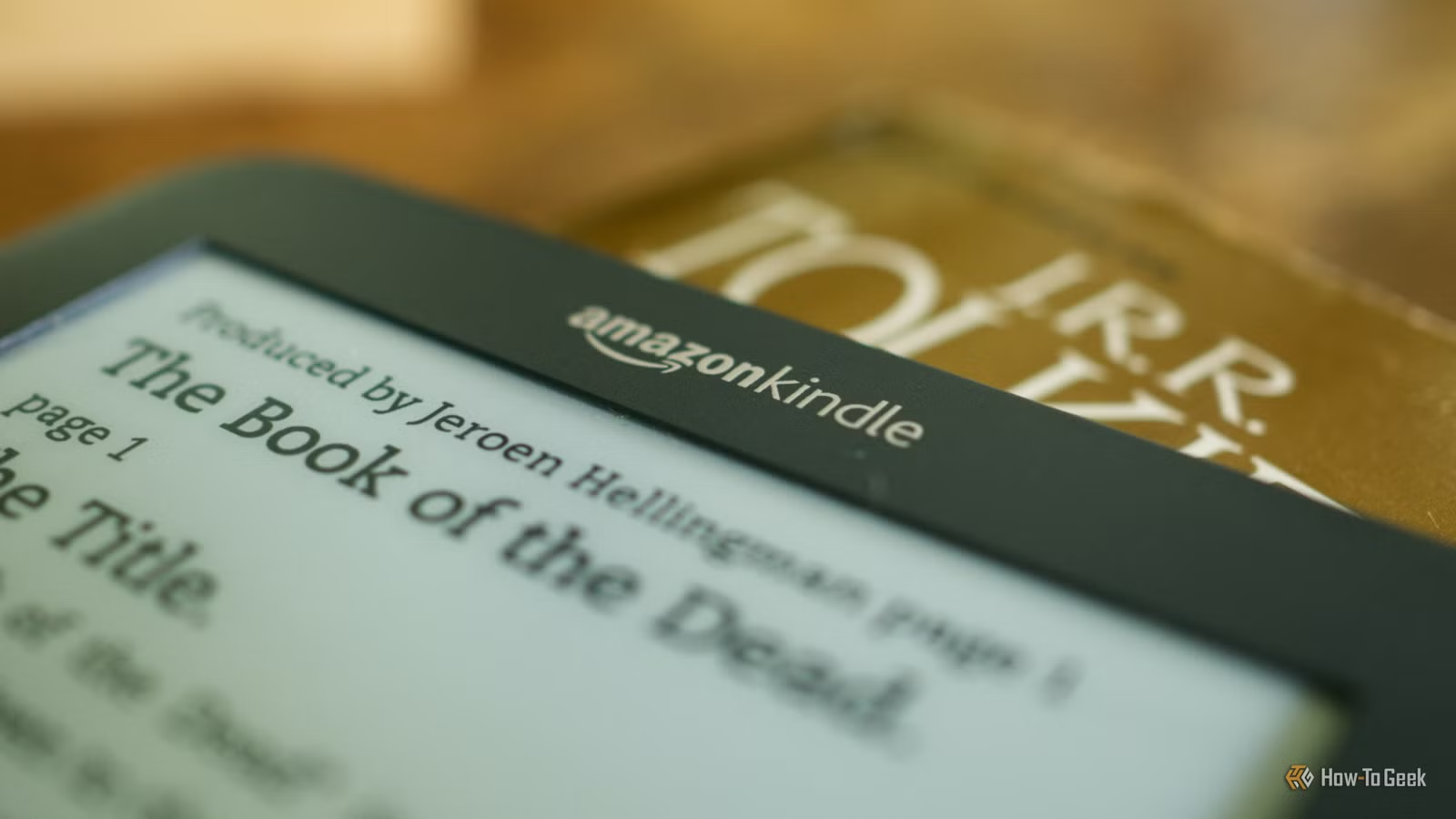
According to [How-To Geek](https://www.howtogeek.com/i-used-to-be-an-ereader-hater-kindle-changed-my-mind/), even devoted physical book readers are converting to e-readers after discovering significant improvements in reading speed and comfort. This shift has implications beyond personal preference—it's a productivity question that business leaders should be asking about their own learning habits.
Read in Short
E-readers aren't just for casual readers. Business leaders report 30-50% faster reading speeds, reduced eye strain during long sessions, and the ability to carry entire business libraries during travel. The ROI on a $150 device becomes clear when you calculate the value of time saved on professional reading.
Why Are Business Leaders Switching to E-Readers?
The stereotype of e-readers as devices for beach novels misses a growing trend: executives and founders are adopting them as professional development tools. The reason is simple math. If you're a CTO who commits to reading 20 industry books a year, and an e-reader helps you finish each one 30% faster, you're recovering dozens of hours annually.
The How-To Geek article highlights several reasons for this speed increase. Adjustable brightness eliminates the need for perfect lighting conditions. The absence of page-turning mechanics removes micro-interruptions. And without visible page numbers, readers often enter flow states that carry them through more content than they planned.
How Do E-Readers Improve Executive Productivity?
For business leaders, the productivity case extends beyond raw reading speed. Consider the friction points in your current reading workflow.

- Travel logistics: Carrying 3-4 business books for a conference trip adds weight and space constraints
- Annotation chaos: Notes scattered across physical books rarely get reviewed or actioned
- Purchase delays: Waiting for shipping means losing momentum on recommended reads
- Multi-device access: Starting a book on your commute and finishing at your desk becomes seamless
The hidden cost here isn't the device—it's the friction tax you pay every time you almost read something but didn't because the book wasn't with you. Kindle's Whispersync means your business library follows you everywhere, accessible in under 60 seconds from purchase to first page.
E-Reader ROI: What Does the Math Actually Look Like?
Let's run the numbers that would matter in a board meeting. A Kindle Paperwhite costs roughly $150. If you value your professional reading time at $100/hour (conservative for senior executives), you need to save just 1.5 hours annually to break even.
| Factor | Physical Books | E-Reader |
|---|---|---|
| Average reading speed | 200-250 words/minute | 260-325 words/minute |
| Time to access new book | 1-3 days (shipping) | Under 60 seconds |
| Weight for 5 books | 3-5 kg | 200 grams |
| Searchable highlights | Manual transcription needed | Instant export |
| Eye strain in low light | High without external light | Adjustable warm light |
The real ROI multiplier comes from knowledge application. When you can instantly search your highlights across 50 books, you're not just reading faster—you're building a searchable personal knowledge base. That's a competitive advantage that compounds over years.
Should Your Company Provide E-Readers for Employees?
Some forward-thinking companies are adding e-readers to their professional development budgets. The logic is straightforward: if you're already spending $500-1,000 per employee on learning stipends, a $150 device that increases the consumption rate of that investment makes financial sense.
The Learning Velocity Argument
Engineering teams that read more stay current with evolving technologies. A 30% increase in reading speed across a 10-person team, each reading 10 professional books annually, translates to roughly 150 additional hours of technical learning per year—without any increase in time investment.
The counter-argument is retention. Some studies suggest physical books offer better recall for certain types of content. However, for business books where the goal is extracting 3-5 actionable insights rather than memorizing details, the speed advantage typically outweighs retention concerns.
Understanding why continuous learning matters more than ever in the current job market
What Features Matter Most for Business Reading?
Not all e-readers are equal for professional use. Here's what to prioritize if you're evaluating options for yourself or your team.
- Highlight export: Can you send your annotations to Notion, Roam, or your note-taking system?
- PDF support: Many whitepapers and industry reports come in PDF format. Native support matters.
- Battery life: A device that lasts weeks, not hours, removes another friction point
- Screen size: 6-inch screens work for novels, but 7-inch or larger helps with business books containing charts
- Warm light: Late-night reading before bed is common for busy executives. Blue light reduction helps sleep quality.
The Kindle Paperwhite Signature Edition and Kobo Sage hit most of these marks. For PDF-heavy readers, the Kindle Scribe or Boox Note Air offer larger screens with stylus support for annotations.
The Surprising Productivity Hack: Hiding Page Numbers
One insight from the How-To Geek piece deserves special attention for business readers. The author discovered that hiding page numbers on her Kindle led to unintentionally longer reading sessions. She'd lose track of her progress and read more than planned.

“I tend to turn off the page numbers on my Kindle, which makes it incredibly difficult to understand where I am in the book, which means I tend to go overboard with reading.”
— Alexandra Ramos, How-To Geek
For business leaders who struggle to prioritize reading time, this is a psychological hack worth trying. The same principle applies to removing distractions: when you don't know how close you are to a milestone, you're less likely to stop early. It's the reading equivalent of removing the clock from your workout.
If you're evaluating device investments for your team, see how budget options are improving
E-Readers vs. Tablets: Which Makes More Sense for Executives?
The obvious question: why not just use an iPad? You already carry one. The answer comes down to attention economics.
✅ Pros
- • E-ink displays eliminate notification temptation
- • Battery measured in weeks, not hours
- • No app store means no productivity-killing rabbit holes
- • Outdoor readability in direct sunlight
- • Lighter weight reduces fatigue during long sessions
❌ Cons
- • Another device to manage and charge
- • Limited to reading (no quick email checks)
- • Black and white only (charts lose detail)
- • Page turn refresh can feel slow initially
The single-purpose nature of e-readers is actually the point. In an attention economy where every device competes for your focus, a tool that can only do one thing well becomes a feature, not a limitation.
Implementation: How to Transition Your Reading Workflow
If you're convinced but unsure how to start, here's a practical 30-day transition plan.
The goal isn't to abandon physical books entirely. The author of the original piece still maintains a physical bookshelf. The goal is to remove friction from professional reading—the books you need to read for your job, not the ones you want to savor.
Logicity's Take
At Logicity, we build AI-powered tools and automation workflows for startups, so we're in the business of optimizing knowledge work. While e-readers aren't our core expertise, the underlying principle resonates with everything we build: reducing friction compounds into massive productivity gains over time. What's interesting about the e-reader shift is how it mirrors the AI adoption curve we're seeing with our clients. Early resistance ('I prefer the old way') gives way to pragmatic acceptance once the time savings become undeniable. We've seen similar patterns with teams adopting AI agents for research—initial skepticism, followed by a revelation moment when they realize they're consuming information 3x faster. For Indian tech businesses specifically, the e-reader case is compelling because of travel patterns. Founders flying between Hyderabad, Bangalore, and Mumbai multiple times a month can reclaim significant reading time with a device that weighs nothing and works offline. The ROI math is even better when you factor in unpredictable airport delays. Our honest take: if you're reading fewer than 5 business books a year, the device probably isn't worth it. But if you're committed to continuous learning—and you should be, given how fast AI is reshaping our industry—the friction reduction alone justifies the investment.
Frequently Asked Questions
Frequently Asked Questions
Is a Kindle worth it for business professionals?
If you read 10+ business books annually, yes. The time savings from faster reading and instant access typically recover the $150 device cost within the first year. The real value comes from building a searchable library of highlights across all your professional reading.
How much faster can you read on an e-reader?
Most users report 30-50% speed improvements. This comes from adjustable lighting, no page-turning friction, and the ability to customize font size. Some readers see even larger gains when they remove visible page numbers, which reduces the temptation to stop at chapter breaks.
Should companies provide e-readers as employee benefits?
It's worth considering if you already have learning stipends. A $150 device that increases the consumption rate of $500-1,000 annual book budgets represents a solid investment. Some companies include them in onboarding kits for technical roles.
What's the best e-reader for business reading in 2026?
For most executives, the Kindle Paperwhite Signature Edition offers the best balance of features and value. If you read many PDFs or want to annotate with a stylus, consider the Kindle Scribe or Boox Note Air. Kobo devices are strong alternatives if you want to avoid Amazon's ecosystem.
Do you retain information better with physical books?
Some studies suggest marginally better retention with physical books for certain content types. However, for business reading where the goal is extracting actionable insights rather than memorization, the speed and searchability advantages of e-readers typically outweigh any retention differences.
Need Help Optimizing Your Team's Productivity?
At Logicity, we help startups and growing businesses implement AI-powered workflows that save hours every week. From automated research tools to knowledge management systems, we build solutions that let your team focus on high-value work. Get in touch to discuss how we can help your organization work smarter.
Source: How-To Geek
Huma Shazia
Senior AI & Tech Writer
اقرأ أيضاً

رأي مغاير: كيف يؤثر اختراق الأمن الداخلي الأميركي على شركاتنا الخاصة؟
في ظل اختراق عقود الأمن الداخلي الأميركي مع شركات خاصة، نناقش تأثير هذا الاختراق على مستقبل الأمن السيبراني. نستعرض الإحصاءات الموثوقة ونناقش كيف يمكن للشركات الخاصة أن تتعامل مع هذا التهديد. استمتع بقراءة هذا التحليل العميق

الإنسان في زمن ما بعد الوجود البشري: نحو نظام للتعايش بين الإنسان والروبوت - Centre for Arab Unity Studies
في هذا المقال، سنناقش كيف يمكن للبشر والروبوتات التعايش في نظام متكامل. سنستعرض التحديات والحلول المحتملة التي تضعها شركات مثل جوجل وأمازون. كما سنلقي نظرة على التوقعات المستقبلية وفقًا لتقرير ماكنزي

إطلاق ناسا لمهمة مأهولة إلى القمر: خطوة تاريخية نحو استكشاف الفضاء
تعتبر المهمة الجديدة خطوة هامة نحو استكشاف الفضاء وتطوير التكنولوجيا. سوف تشمل المهمة إرسال رواد فضاء إلى سطح القمر لconducting تجارب علمية. ستسهم هذه المهمة في تطوير فهمنا للفضاء وتحسين التكنولوجيا المستخدمة في استكشاف الفضاء.