5 ESP32 Alternatives for Microcontroller Projects in 2026
Key Takeaways
- The ESP8266 offers similar Wi-Fi capabilities to ESP32 at lower cost, ideal for bulk orders
- Raspberry Pi Pico 2's RP2350 chip includes both RISC-V and ARM cores you can use simultaneously
- Nordic's nRF54 series delivers 50% lower power consumption than previous Bluetooth SoCs
Espressif's ESP32 has been the default choice for hobbyists and engineers building connected projects. It's cheap, versatile, and available in configurations for almost any use case. But the microcontroller market has fragmented. Chips now specialize in edge AI, ultra-low power consumption, or high-speed hardware control. Depending on your project's priorities, an ESP32 alternative might serve you better.
ESP8266: The Budget Option That Still Works
The ESP8266 predates the ESP32 and remains useful for simpler projects. It's a single-core, Wi-Fi-only chip. No Bluetooth. Fewer GPIO pins. Less processing power. But it costs less, and that gap widens when you're ordering hundreds of units for a commercial product or large installation.
Software support remains strong. Espressif maintains an official SDK, and the chip works with ESPHome, MicroPython, Tasmota, and the open-source ESP-Open-SDK. If you're already familiar with ESP32 development, the transition is straightforward.
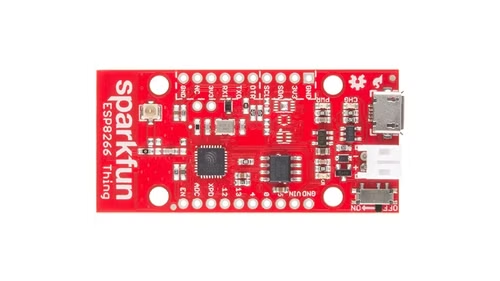
The performance ceiling is real, though. WLED, the popular LED control firmware, illustrates the difference: ESP32 can drive up to 10 LED outputs per chip, while ESP8266 maxes out at three. For simple sensors, switches, or single-purpose IoT devices, that limitation won't matter. For anything computationally demanding, it will.
Raspberry Pi Pico 2: Dual Architecture Without Wi-Fi
The Raspberry Pi Pico 2 uses the RP2350 chip, an evolution of the RP2040 in the original Pico. Its most unusual feature: the chip contains both two RISC-V cores and two ARM Cortex cores. You can run both RISC-V cores, both ARM cores, or one of each simultaneously.
The base Pico 2 has no wireless connectivity. If you need Wi-Fi or Bluetooth, you'll need a "W" variant. This makes the standard Pico 2 better suited for projects where wireless adds complexity you don't want, like industrial control systems, custom peripherals, or educational robotics.
The RP2350's Programmable I/O (PIO) state machines received a major upgrade. They now deliver 12 times the throughput of the RP2040's PIO, letting you implement custom protocols and timing-critical interfaces directly in hardware. That's useful for driving displays, reading sensors with unusual protocols, or emulating legacy hardware.
Nordic nRF54: When Battery Life Is Everything
Nordic Semiconductor's nRF54 series targets wearables, medical devices, and any application where battery life matters more than raw performance. These chips specialize in Bluetooth Low Energy with aggressive power management.
The power savings are substantial. Nordic claims 50% lower active power consumption compared to their previous-generation Bluetooth SoCs. For a fitness tracker that needs to run for weeks on a small battery, or a medical sensor that can't be recharged frequently, that difference is the entire value proposition.
“The era of the 'general-purpose' microcontroller is splitting into specialized domains: ultra-low power for wearables, and high-performance edge computing for industrial intelligence.”
— Sarah Jenkins, Lead Hardware Analyst at TechInsights
The trade-off: nRF chips aren't general-purpose workhorses. They're optimized for a specific use case. If your project doesn't prioritize battery life above all else, you're paying for capabilities you won't use.
STM32: The Industrial Standard
STMicroelectronics' STM32 family has been the backbone of industrial embedded systems for years. The chips span a wide performance range, from low-power microcontrollers to application processors capable of running Linux. Automotive, medical, and industrial equipment manufacturers often default to STM32 because of its track record, documentation, and long-term availability guarantees.
For hobbyists, STM32 has a steeper learning curve than ESP32. The development environment is more complex, and community resources skew toward professional engineers rather than weekend tinkerers. If you're prototyping a commercial product that needs to scale to production, starting with STM32 avoids a chip migration later.
Edge AI Chips: The Emerging Category
The global Edge AI microcontroller market is projected to hit $1.5 billion by 2027. These chips integrate neural network accelerators directly into the silicon, enabling on-device machine learning without sending data to the cloud.
Espressif has added AI capabilities to some ESP32 variants, but dedicated edge AI chips from companies like Syntiant, Hailo, and Google's Coral line offer more processing power for vision and audio ML tasks. If your project involves voice recognition, object detection, or predictive maintenance, these specialized chips may outperform general-purpose microcontrollers by an order of magnitude.
How to Choose
| Chip | Best For | Connectivity | Key Trade-off |
|---|---|---|---|
| ESP8266 | Budget IoT, bulk orders | Wi-Fi only | Limited processing power |
| RP2350 (Pico 2) | Custom protocols, education | None (W variant adds Wi-Fi) | No built-in wireless |
| Nordic nRF54 | Wearables, battery-powered | Bluetooth LE | Not general-purpose |
| STM32 | Industrial, commercial products | Varies by model | Steeper learning curve |
| Edge AI chips | On-device ML | Varies | Narrow use case |
The ESP32 remains the right choice for most projects that need Wi-Fi, Bluetooth, and reasonable processing power at a low price. It's the safe default. But defaults aren't always optimal. If your project has a specific constraint, whether that's cost per unit, battery life, processing speed, or ML capability, one of these alternatives might fit better.
Hardware performance can be bottlenecked by overlooked components
Community Perspectives
The embedded systems community has strong opinions about chip selection. On Reddit's r/embedded, developers are debating the RP2350's dual-architecture approach. Some see it as flexibility; others question whether anyone will actually mix RISC-V and ARM cores in practice.
HackerNews discussions tend to focus on development tools. ESP32 fans point to ESP-IDF's ease of use. Industrial developers counter that real-time operating systems like Zephyr, which runs better on STM32 and nRF chips, provide the deterministic performance that serious applications require.
Logicity's Take
The ESP32's dominance created a monoculture in hobbyist electronics. That's changing. Engineers building products, not just prototypes, should match their chip to their constraints rather than defaulting to what worked last time. The learning curve for a new chip is usually shorter than fighting the wrong chip's limitations for months.
Frequently Asked Questions
Is the ESP8266 still worth using in 2026?
Yes, for simple Wi-Fi connected projects where cost matters. It handles basic IoT tasks well and costs less than ESP32, especially in bulk. Avoid it for anything computationally intensive.
Can the Raspberry Pi Pico 2 connect to Wi-Fi?
The base Pico 2 has no wireless connectivity. You need the Pico 2 W variant for Wi-Fi and Bluetooth support.
What's the advantage of the RP2350's dual RISC-V and ARM cores?
You can choose the architecture that best fits your application or use both simultaneously. RISC-V is open-source and gaining momentum; ARM is mature with extensive tooling. Having both provides flexibility.
When should I use an STM32 instead of ESP32?
Choose STM32 for commercial products requiring long-term chip availability, industrial certifications, or when you need a wide range of performance options from the same vendor ecosystem.
What are edge AI microcontrollers used for?
On-device machine learning tasks like voice recognition, object detection, and anomaly detection. They process data locally without sending it to cloud servers, reducing latency and improving privacy.
Need Help Implementing This?
Choosing the right microcontroller for your product can determine whether you hit your cost, power, and performance targets. If you're evaluating ESP32 alternatives for a commercial project, reach out to Logicity's technical team for guidance on chip selection and development workflows.
Source: How-To Geek
Manaal Khan
Tech & Innovation Writer
اقرأ أيضاً

رأي مغاير: كيف يؤثر اختراق الأمن الداخلي الأميركي على شركاتنا الخاصة؟
في ظل اختراق عقود الأمن الداخلي الأميركي مع شركات خاصة، نناقش تأثير هذا الاختراق على مستقبل الأمن السيبراني. نستعرض الإحصاءات الموثوقة ونناقش كيف يمكن للشركات الخاصة أن تتعامل مع هذا التهديد. استمتع بقراءة هذا التحليل العميق

الإنسان في زمن ما بعد الوجود البشري: نحو نظام للتعايش بين الإنسان والروبوت - Centre for Arab Unity Studies
في هذا المقال، سنناقش كيف يمكن للبشر والروبوتات التعايش في نظام متكامل. سنستعرض التحديات والحلول المحتملة التي تضعها شركات مثل جوجل وأمازون. كما سنلقي نظرة على التوقعات المستقبلية وفقًا لتقرير ماكنزي

إطلاق ناسا لمهمة مأهولة إلى القمر: خطوة تاريخية نحو استكشاف الفضاء
تعتبر المهمة الجديدة خطوة هامة نحو استكشاف الفضاء وتطوير التكنولوجيا. سوف تشمل المهمة إرسال رواد فضاء إلى سطح القمر لconducting تجارب علمية. ستسهم هذه المهمة في تطوير فهمنا للفضاء وتحسين التكنولوجيا المستخدمة في استكشاف الفضاء.