The RCCF Method: A Better Way to Prompt Claude AI
Key Takeaways
- RCCF stands for Role, Context, Command, and Format, which structures AI prompts for better outputs
- The method works because AI models lack consciousness and goals, requiring explicit guidance to produce useful responses
- Using RCCF transforms Claude from a generic chatbot into a specialized assistant for specific tasks
There's a growing consensus that AI has gotten dumb. People complain about lackluster responses from even the most capable chatbots. But the problem isn't the AI. It's us.
We've become overly reliant on AI chatbots to do our thinking. We feed them lazy prompts and expect magic. Combined with safety guardrails that have made these models more reserved, the results are often disappointing.
A Reddit thread recently surfaced a prompting technique called RCCF that addresses this exact problem. It's a simple framework that structures how you communicate with Claude AI, and it produces dramatically better results than throwing vague requests at the chatbot.
Why AI Chatbots Need Structure
AI models lack true cognitive abilities. They have no consciousness, no goals, no personal experiences. When you ask them to solve a problem without clear intent, you get a cluster of raw, unstructured information.
The mistake is expecting AI to think for you. It can't conjure an original voice on your behalf without guidance. At best, it should steer you in the right direction. It needs explicit instructions to do even that.
This is where RCCF comes in. Think of it as role-playing with Claude, commanding it to act in a specific manner rather than letting it guess what you want.
What RCCF Stands For
The RCCF method breaks down into four components that give Claude everything it needs to produce useful output:
- Role: Define the function Claude should take up. Are you talking to a lawyer, a marketer, a developer, or a teacher?
- Context: Explain the relevant information. What's the situation? Who's the audience? What constraints exist?
- Command: Give a specific instruction. What exactly do you want Claude to do?
- Format: Specify the layout you need. A bullet list? A formal email? A comparison table?
Each element removes ambiguity. Without a role, Claude defaults to generic assistant mode. Without context, it can't tailor the response. Without a clear command, it guesses at your intent. Without format specifications, you get whatever structure it thinks is appropriate.
RCCF in Practice: A Marketing Example
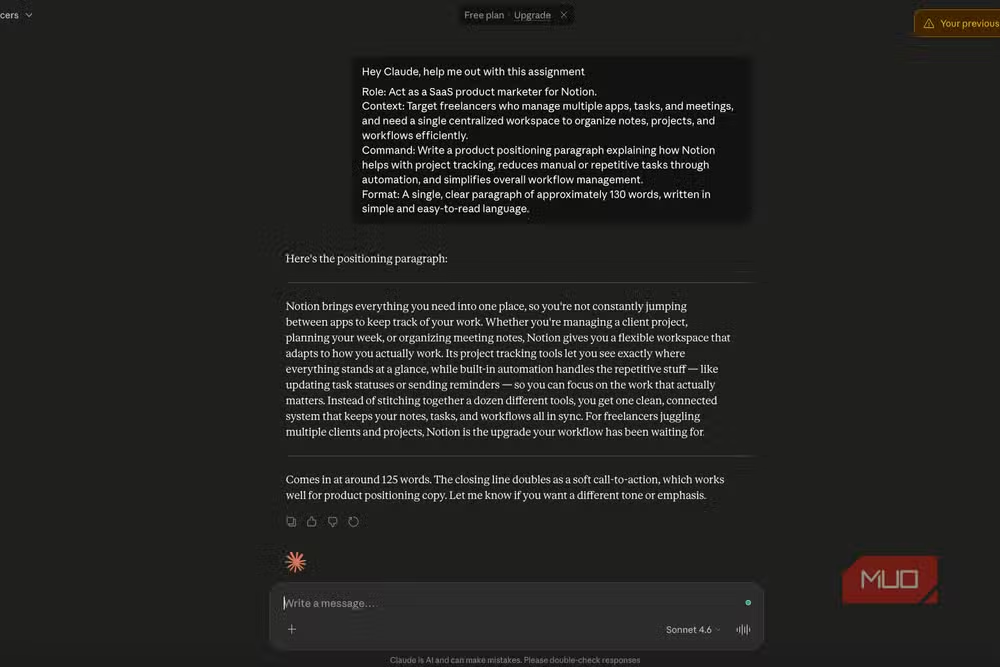
Here's how the method works with a real example. Say you need marketing copy for Notion targeting freelancers.
A lazy prompt would be: "Write marketing copy for Notion." Claude will produce something generic that could apply to anyone.
An RCCF prompt looks different:
- Role: You are a SaaS product marketer for Notion.
- Context: Your target audience is freelancers who juggle several apps and meetings. They need a platform to organize tasks, journal, and capture thoughts.
- Command: Write three headline options and a 100-word product description.
- Format: Present headlines as a numbered list, followed by the description as a single paragraph.
The output is immediately more useful. Claude knows who it's writing for, what problems to address, exactly what deliverables you need, and how to structure them.
Push vs. Pull: Two Ways to Use RCCF
The RCCF method works in two modes. The push method involves providing all four elements upfront in a single prompt. You give Claude everything it needs and let it execute.
The pull method is more conversational. You start with a basic request and let Claude ask clarifying questions. As it asks about role, context, or format preferences, you fill in the gaps. This works well when you're not entirely sure what you need.
Push is faster when you know exactly what you want. Pull helps when you're still figuring out the task.
Why This Works Better Than Default Prompting
Claude is already one of the more capable AI chatbots available. The limiting factor is usually the input, not the model. RCCF addresses the input problem directly.
By defining a role, you activate specific knowledge domains. A "SaaS marketer" prompt draws on different training data than a "technical writer" prompt. Context narrows the focus further. Commands eliminate guesswork. Format ensures the output is immediately usable.
The method also helps you think through what you actually need before you ask. Many frustrating AI interactions stem from users not knowing what they want. RCCF forces clarity on your end, which translates to clarity in the output.
Logicity's Take
Getting Started with RCCF
Start with tasks you already use Claude for. Pick one that consistently produces mediocre results. Rewrite your prompt using the RCCF structure. Compare the outputs.
Common use cases that benefit from RCCF:
- Writing emails, proposals, or documentation
- Summarizing research or long documents
- Generating marketing copy or social posts
- Brainstorming product features or solutions
- Explaining technical concepts to non-technical audiences
The method scales. Complex multi-step tasks benefit even more from structured prompts than simple requests.
Related coverage on AI chatbot developments
Frequently Asked Questions
Does RCCF work with other AI chatbots besides Claude?
Yes. The method applies to any large language model including ChatGPT, Gemini, and others. The principle of structured prompting improves output quality across all major AI chatbots.
Do I need to use all four RCCF elements every time?
Not always. Simple tasks might only need Command and Format. But for complex or specialized tasks, all four elements produce significantly better results.
Is RCCF the same as prompt engineering?
RCCF is one prompt engineering technique. It provides a simple framework that anyone can use without deep technical knowledge of how language models work.
How long should each RCCF element be?
Keep each element concise but complete. A few sentences per element is usually enough. The goal is clarity, not length.
Need Help Implementing This?
Source: MakeUseOf
Manaal Khan
Tech & Innovation Writer
اقرأ أيضاً

رأي مغاير: كيف يؤثر اختراق الأمن الداخلي الأميركي على شركاتنا الخاصة؟
في ظل اختراق عقود الأمن الداخلي الأميركي مع شركات خاصة، نناقش تأثير هذا الاختراق على مستقبل الأمن السيبراني. نستعرض الإحصاءات الموثوقة ونناقش كيف يمكن للشركات الخاصة أن تتعامل مع هذا التهديد. استمتع بقراءة هذا التحليل العميق

الإنسان في زمن ما بعد الوجود البشري: نحو نظام للتعايش بين الإنسان والروبوت - Centre for Arab Unity Studies
في هذا المقال، سنناقش كيف يمكن للبشر والروبوتات التعايش في نظام متكامل. سنستعرض التحديات والحلول المحتملة التي تضعها شركات مثل جوجل وأمازون. كما سنلقي نظرة على التوقعات المستقبلية وفقًا لتقرير ماكنزي

إطلاق ناسا لمهمة مأهولة إلى القمر: خطوة تاريخية نحو استكشاف الفضاء
تعتبر المهمة الجديدة خطوة هامة نحو استكشاف الفضاء وتطوير التكنولوجيا. سوف تشمل المهمة إرسال رواد فضاء إلى سطح القمر لconducting تجارب علمية. ستسهم هذه المهمة في تطوير فهمنا للفضاء وتحسين التكنولوجيا المستخدمة في استكشاف الفضاء.