Supreme Court Judge Says AI Can't Replace Judicial Reasoning: What This Means for India's Courts
Key Takeaways
- AI and digital tools should only assist judges, never override their reasoning
- Data confidentiality is a major concern with open-source platforms in courts
- The two-day conference brought together SC judges, high court justices, and IT coordinators
- Multiple high courts showcased their tech advancements during the event
- Judicial reforms and technology integration remain a priority for the Supreme Court
Read in Short
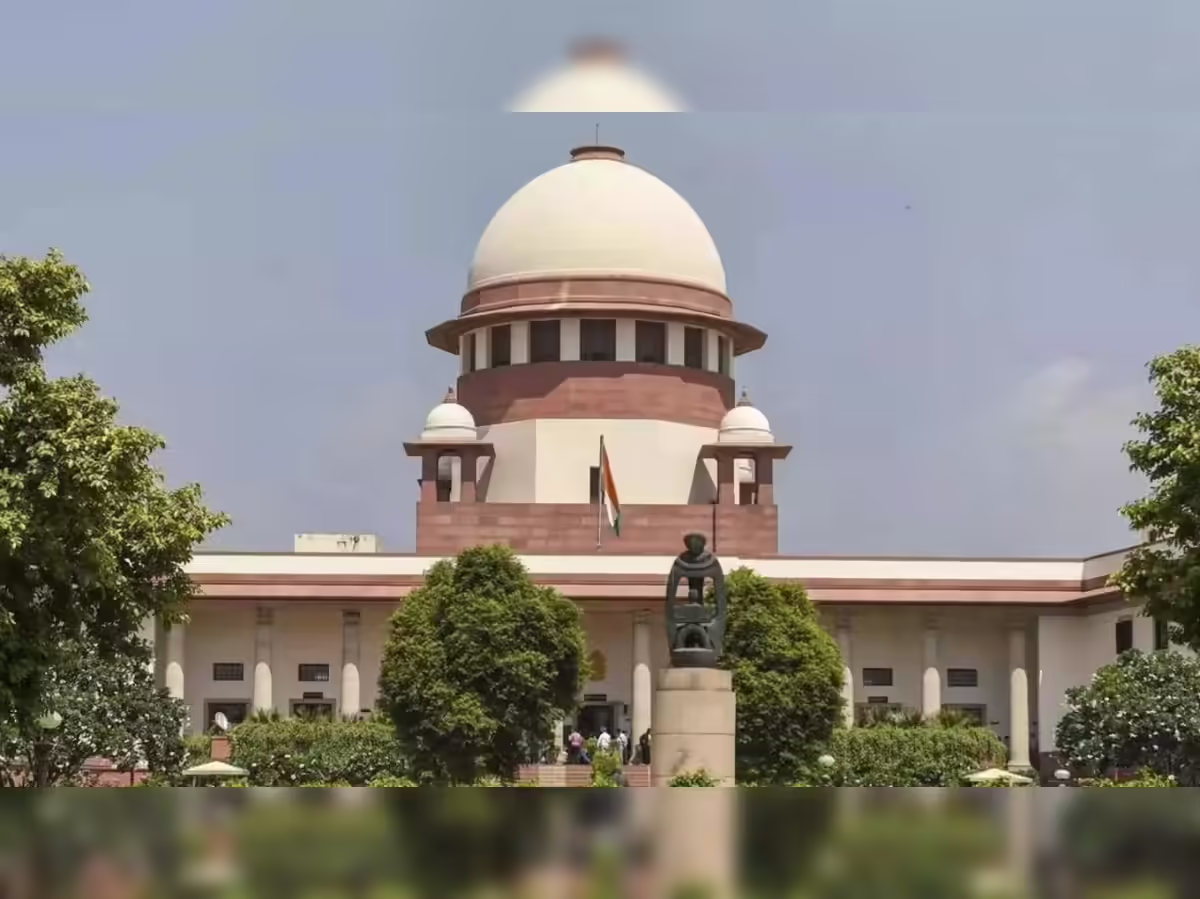
Supreme Court Justice Rajesh Bindal just drew a line in the sand: AI can help judges, but it absolutely cannot replace human judicial reasoning. Speaking at a national conference on digital transformation in courts, he also raised red flags about data security when using open-source tools. The message is clear, tech is a tool, not a replacement for the humans wearing the robes.
Here's a question that's going to define the next decade of legal systems worldwide: how much should we let AI do in courtrooms? In India, we just got a pretty definitive answer from someone who matters.
Justice Rajesh Bindal of the Supreme Court didn't mince words at the national conference on 'Judicial Process Re-engineering and Digital Transformation' held on April 11-12. The event was organized by the apex court's eCommittee along with the Department of Justice, and it brought together some seriously heavy hitters. We're talking Supreme Court judges, chief justices from various high courts, and IT coordinators from across the country.
The Core Message: Tech as Assistant, Not Judge
So what exactly did Justice Bindal say? He was chairing the fourth working session on day two when he laid out the principle that's probably going to guide Indian courts for years to come. AI and digital tools, he said, must be used solely as supportive instruments. They should never be allowed to override judicial reasoning.
Think about that for a second. We're living in a time when ChatGPT can pass bar exams and AI tools are being pitched as solutions for everything from legal research to predicting case outcomes. And here's a sitting Supreme Court judge saying, essentially, pump the brakes.
“AI and digital tools must be used as supportive instruments and should not be allowed to override judicial reasoning.”
— Justice Rajesh Bindal, Supreme Court of India
This isn't just philosophical hand-wringing. It's a practical stance on a very real issue. Courts around the world are experimenting with AI for everything from document analysis to bail recommendations. Some of these experiments have gone badly wrong. Remember the COMPAS algorithm in the US that was found to be biased against Black defendants? That's the kind of thing Justice Bindal seems to be warning against.
The Open-Source Problem Nobody's Talking About
But the AI stuff wasn't even the most interesting part of Justice Bindal's remarks. He also raised concerns about open-source platforms and data confidentiality. And honestly? This is huge.
Why Open-Source Matters Here
Open-source software is typically free and transparent, which sounds great for cash-strapped courts. But when sensitive case data, witness information, or confidential judgments flow through these systems, who's responsible for security? That's the question Justice Bindal is raising.
Courts handle some of the most sensitive data imaginable. We're talking about victim testimonies, financial records in fraud cases, family disputes, criminal evidence. If that data leaks because someone used an insecure open-source tool, the consequences could be catastrophic.
The tricky part is that open-source tools are often exactly what under-resourced courts can afford. Proprietary solutions cost money. Open-source is free. But free doesn't mean secure, and Justice Bindal seems to understand that trade-off better than most tech enthusiasts.
If you're interested in the philosophical questions around AI decision-making, this piece on Anthropic's unusual approach to AI ethics is worth your time.
What the Conference Actually Covered
Let's zoom out and look at the bigger picture. This wasn't just Justice Bindal giving a speech. It was a structured two-day event with multiple sessions tackling different angles of the same problem: how do we modernize Indian courts without losing what makes them work?
- Sessions 1-3 on Day One focused on discussions with experts and stakeholders about tech integration in justice delivery
- Session 4 on Day Two, chaired by Justice Bindal, addressed the role of AI and digital tools
- Session 5 highlighted tech advancements from various high courts, chaired by Justice Sandeep Mehta
- The valedictory address by Justice J K Maheshwari emphasized continued judicial reforms
The fifth session sounds particularly interesting. Different high courts showcased what they've been doing with technology. India's judiciary is massive and decentralized, so you've got courts at different stages of digital adoption. Some are probably still drowning in paper files. Others might be running sophisticated case management systems. This kind of knowledge sharing is exactly what's needed.
The Global Context: India Isn't Alone
India's not the only country wrestling with these questions. Courts in the UK, US, China, and across Europe are all trying to figure out where AI fits in their systems. Some have been more aggressive about adoption. Others are taking the cautious route.
- Chinese courts have deployed AI judges for simple civil disputes
- UK courts use AI for legal research and document review
- US courts have faced backlash over biased risk assessment algorithms
- European courts are governed by strict GDPR rules that limit AI use with personal data
What makes India's situation unique is scale. The country has one of the largest case backlogs in the world. Millions of cases pending, some for decades. The temptation to throw AI at this problem must be enormous. And yet, Justice Bindal is urging caution.
That's actually pretty wise. Moving fast and breaking things works fine for startups. It's a terrible approach for systems that determine whether people go to prison.
What This Means for You
Okay, so you're probably not a judge. Why should you care about this conference?
Look, if you ever interact with the Indian legal system, in any capacity, these decisions affect you directly. As a plaintiff, defendant, witness, or just someone who might need courts to function properly someday, you have skin in this game.
The direction India takes on AI in courts will also influence other developing countries. India often serves as a model for nations at similar stages of digital transformation. Get this right, and it could set a positive template. Get it wrong, and we might see the mistakes replicated across the Global South.
For more on how AI is being integrated into everyday tools (sometimes helpfully, sometimes not), check out what's happening with hardware.
The Road Ahead
Justice J K Maheshwari wrapped up the conference by emphasizing that judicial reforms and tech advancement need to continue working together. That's the balancing act, right? You can't pretend technology doesn't exist. But you also can't let it run the show.
The Supreme Court's eCommittee, which organized this whole thing, has been driving digital initiatives across Indian courts for a while now. They've pushed for e-filing, video conferencing for hearings, and digital case tracking. So it's not like the judiciary is anti-tech. They're just trying to be smart about which technologies they adopt and how much authority they give them.
The Bottom Line
AI will absolutely transform courts. But transformation doesn't mean replacement. Justice Bindal's message, that human reasoning must stay at the center, might be the most important guardrail we set in this process.
The conference brought together central project coordinators and IT committee members from high courts across the country. These are the people who'll actually implement whatever policies emerge from these discussions. Having them in the room, hearing directly from Supreme Court judges about priorities and concerns, matters more than any policy document ever could.
So where does this leave us? With a clear principle and a lot of work ahead. AI can help with research, document analysis, scheduling, and a hundred other administrative tasks. But when it comes to the actual reasoning, the weighing of evidence, the interpretation of law, the human stays in charge. That's not being anti-technology. That's being pro-justice.
Frequently Asked Questions
Can AI currently be used in Indian courts?
Yes, but only as an assistive tool. AI can help with research, document management, and case tracking. It cannot make judicial decisions or override a judge's reasoning.
What open-source concerns did Justice Bindal raise?
He flagged that using open-source platforms in courts could pose risks to data confidentiality. Courts handle sensitive information, and not all open-source tools have adequate security measures.
Who attended the conference?
Supreme Court judges, chief justices and judges from various high courts, central project coordinators, and IT committee members from high courts across India.
Will AI eventually replace judges in India?
Based on Justice Bindal's remarks, that's not the direction the judiciary is heading. The emphasis is on AI as a supportive tool, with human judgment remaining central to the process.
Sources & Credits
Originally reported by Tech-Economic Times — ET
Huma Shazia
Senior AI & Tech Writer
اقرأ أيضاً

رأي مغاير: كيف يؤثر اختراق الأمن الداخلي الأميركي على شركاتنا الخاصة؟
في ظل اختراق عقود الأمن الداخلي الأميركي مع شركات خاصة، نناقش تأثير هذا الاختراق على مستقبل الأمن السيبراني. نستعرض الإحصاءات الموثوقة ونناقش كيف يمكن للشركات الخاصة أن تتعامل مع هذا التهديد. استمتع بقراءة هذا التحليل العميق

الإنسان في زمن ما بعد الوجود البشري: نحو نظام للتعايش بين الإنسان والروبوت - Centre for Arab Unity Studies
في هذا المقال، سنناقش كيف يمكن للبشر والروبوتات التعايش في نظام متكامل. سنستعرض التحديات والحلول المحتملة التي تضعها شركات مثل جوجل وأمازون. كما سنلقي نظرة على التوقعات المستقبلية وفقًا لتقرير ماكنزي

إطلاق ناسا لمهمة مأهولة إلى القمر: خطوة تاريخية نحو استكشاف الفضاء
تعتبر المهمة الجديدة خطوة هامة نحو استكشاف الفضاء وتطوير التكنولوجيا. سوف تشمل المهمة إرسال رواد فضاء إلى سطح القمر لconducting تجارب علمية. ستسهم هذه المهمة في تطوير فهمنا للفضاء وتحسين التكنولوجيا المستخدمة في استكشاف الفضاء.