SpaceX Unveils 11M Sq Ft Gigasat Factory for Orbital Data Centers
Key Takeaways
- SpaceX is building an 11-million-square-foot factory in Bastrop, Texas to manufacture AI satellites for orbital data centers
- The company targets 1 gigawatt of space-based AI compute capacity by late 2027, requiring over 6,000 satellite launches
- Each AI1 satellite spans 70 meters and carries 150 kilowatts of compute power, cooled by double-sided radiators in space
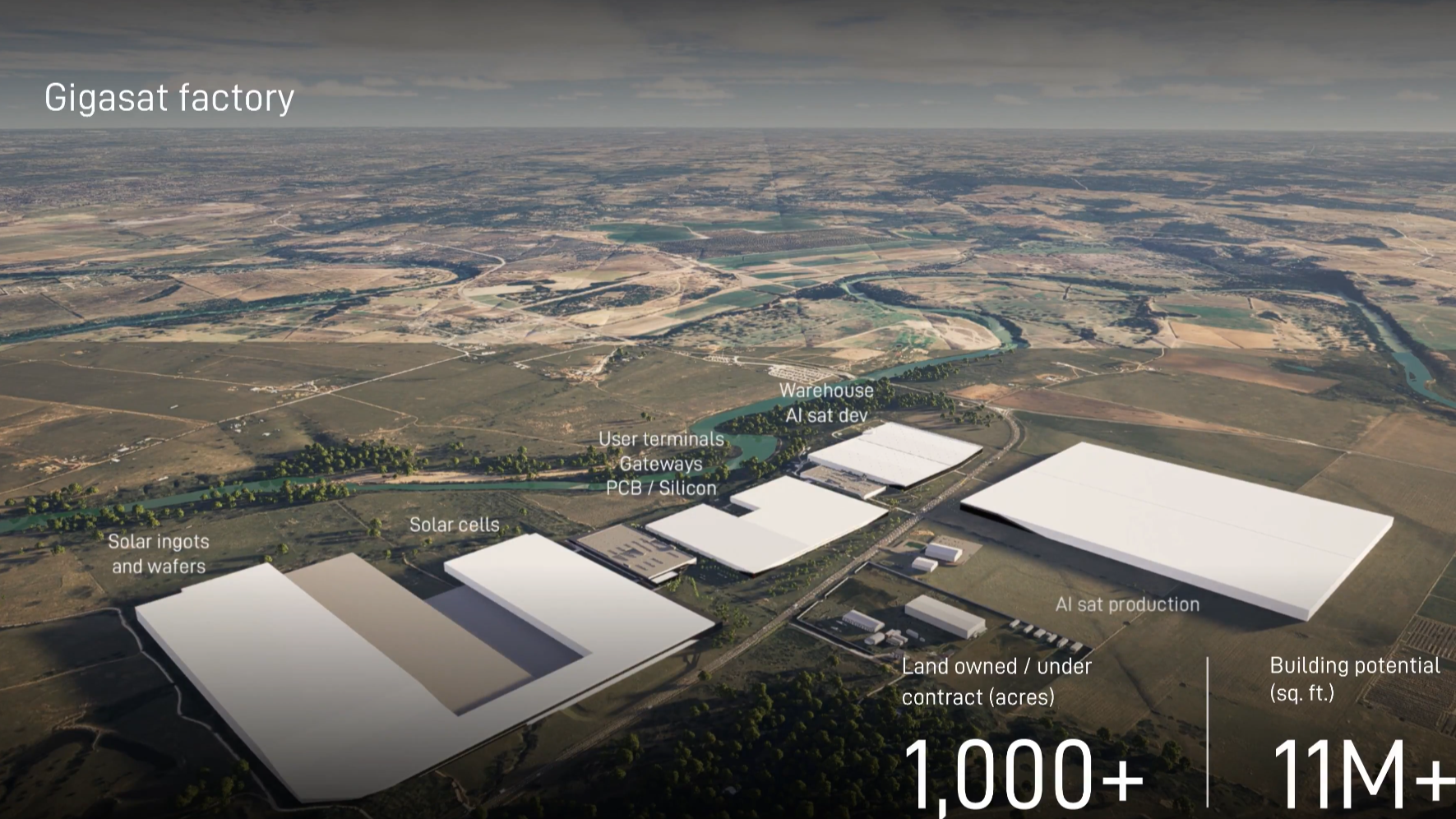
SpaceX is betting big on space-based computing. The company announced a new 11-million-square-foot manufacturing facility in Bastrop, Texas called the Gigasat factory. Its sole purpose: building the infrastructure for orbital data centers.
In an interview posted on X on June 8, CEO Elon Musk confirmed the facility will start producing complete AI satellites by 2027. SpaceX is targeting 1 gigawatt of orbital AI compute capacity by the end of next year. After that, the company plans to scale by an order of magnitude each year.
Inside the AI1 Satellite Design
Musk unveiled the specifications for the AI1 satellite during the interview. The satellite spans roughly 70 meters (about 230 feet), with a massive solar array making up most of the structure. The array generates power at a density of 250 watts per square meter.
Cooling is handled by vertically oriented, double-sided radiators. The 150-kilowatt peak compute payload sits in the middle of the structure. This design takes advantage of space's natural thermal properties. Radiative cooling in vacuum is far more efficient than anything achievable on Earth.
Vertical Integration on a Single Campus
The 1,000-acre Gigasat site will vertically integrate nearly the entire AI1 supply chain. The facility will manufacture solar ingots and wafers, solar cells, printed circuit boards, silicon-based electronic components, user terminals, gateways, and the satellites themselves.
The campus will also include dedicated satellite development and testing facilities, warehousing and logistics infrastructure, and a large-scale AI satellite production line. According to Musk, solar manufacturing facilities are already under construction. The AI satellite production building is about to break ground.
The Scale Problem: 6,000+ Satellites Per Year
Here is where the math gets interesting. Each AI1 satellite carries 150 kilowatts of compute power. To hit 1 gigawatt per year, SpaceX would need to launch more than 6,000 AI1 satellites in a single year.
For context: Starlink has about 10,500 active satellites as of June 2026. SpaceX would need to nearly match that entire constellation in AI satellites alone, every year, starting in 2027.
Musk's ambitions go further. He hopes to scale to 100 gigawatts per year by 2030. He even mentioned terrawatt-level computing, completely solar-powered in space.
Another look at how hardware constraints shape AI deployment
Why Put Data Centers in Space?
The logic has two parts: power and cooling.
Terrestrial data centers face growing constraints. They consume enormous amounts of electricity. They generate massive amounts of heat that must be dissipated. Both problems are getting worse as AI models grow larger and more power-hungry.
In space, solar power is constant and abundant. There is no night cycle, no weather, no atmosphere absorbing sunlight. Radiative cooling in vacuum is highly efficient. The cold of space itself becomes an asset.
SpaceX is leveraging its deep expertise in mass-producing Starlink satellites and laser inter-satellite links. The company has already proven it can build and launch satellites at unprecedented scale. This is an extension of that capability into a new market.
Technical Questions Remain
The space computing concept faces real challenges. Launch costs matter enormously when you are talking about thousands of satellites. Radiation in orbit degrades electronics over time. Latency for real-time AI inference could be problematic depending on orbital altitude.
Online discussions on HackerNews have focused on the technical feasibility of radiative cooling for high-density compute. Some are skeptical about launch costs at the required mass. Others point to strategic implications of moving Big Tech infrastructure into orbit.
Reddit communities on r/SpaceX and r/ArtificialIntelligence are speculating on satellite design specs and the potential impact on latency for AI inference. The massive land-use scale of the Bastrop facility has also drawn attention.
Logicity's Take
Timeline and Next Steps
SpaceX expects to produce a "reasonable volume" of orbital data centers by the end of 2027. Solar manufacturing facilities are already under construction at the Bastrop site. The AI satellite production building breaks ground soon.
The 2027 target for 1 gigawatt of space AI compute is aggressive. The 2030 target of 100 gigawatts per year is more aggressive still. Whether SpaceX hits those numbers will depend on manufacturing scale, launch cadence, and whether the satellites actually perform as designed in orbit.
More on hardware requirements driving AI compute decisions
Frequently Asked Questions
What is the SpaceX Gigasat factory?
The Gigasat factory is an 11-million-square-foot manufacturing facility in Bastrop, Texas dedicated to building AI satellites for space-based data centers. It will vertically integrate solar cell production, electronics manufacturing, and satellite assembly on a single 1,000-acre campus.
How much compute power will each AI1 satellite have?
Each AI1 satellite will carry 150 kilowatts of peak compute power. The satellites span 70 meters and use massive solar arrays generating power at 250 watts per square meter.
When will SpaceX orbital data centers be operational?
SpaceX expects to produce a reasonable volume of AI satellites by the end of 2027, targeting 1 gigawatt of total orbital AI compute capacity by that time.
Why is SpaceX building data centers in space?
Space offers two advantages for data centers: constant solar power without day-night cycles or weather, and efficient radiative cooling in vacuum. These address the two biggest constraints facing terrestrial data centers as AI workloads grow.
How many AI satellites does SpaceX need to launch?
To hit 1 gigawatt per year with 150-kilowatt satellites, SpaceX would need to launch more than 6,000 AI1 satellites annually. For comparison, the entire Starlink constellation has about 10,500 active satellites as of June 2026.
Need Help Implementing This?
Source: Latest from Tom's Hardware
Manaal Khan
Tech & Innovation Writer
اقرأ أيضاً

رأي مغاير: كيف يؤثر اختراق الأمن الداخلي الأميركي على شركاتنا الخاصة؟
في ظل اختراق عقود الأمن الداخلي الأميركي مع شركات خاصة، نناقش تأثير هذا الاختراق على مستقبل الأمن السيبراني. نستعرض الإحصاءات الموثوقة ونناقش كيف يمكن للشركات الخاصة أن تتعامل مع هذا التهديد. استمتع بقراءة هذا التحليل العميق

الإنسان في زمن ما بعد الوجود البشري: نحو نظام للتعايش بين الإنسان والروبوت - Centre for Arab Unity Studies
في هذا المقال، سنناقش كيف يمكن للبشر والروبوتات التعايش في نظام متكامل. سنستعرض التحديات والحلول المحتملة التي تضعها شركات مثل جوجل وأمازون. كما سنلقي نظرة على التوقعات المستقبلية وفقًا لتقرير ماكنزي

إطلاق ناسا لمهمة مأهولة إلى القمر: خطوة تاريخية نحو استكشاف الفضاء
تعتبر المهمة الجديدة خطوة هامة نحو استكشاف الفضاء وتطوير التكنولوجيا. سوف تشمل المهمة إرسال رواد فضاء إلى سطح القمر لconducting تجارب علمية. ستسهم هذه المهمة في تطوير فهمنا للفضاء وتحسين التكنولوجيا المستخدمة في استكشاف الفضاء.