NASA June 2026 Skywatching: Venus-Jupiter Conjunction Leads
Key Takeaways
- Venus and Jupiter will appear 1.5 degrees apart on June 9, visible in the western sky after sunset
- The Moon will pass in front of Venus on June 17, visible from parts of the US, Canada, Brazil, and Venezuela
- The June solstice arrives on June 21 at 08:25 UTC, marking the longest day in the Northern Hemisphere
NASA has released its skywatching guide for June 2026, and the month delivers one of the better planetary lineups of the year. Venus and Jupiter, the two brightest planets visible from Earth, will appear to nearly touch in the western sky on June 9. Mercury joins them by mid-month. And on June 17, the Moon will slide directly in front of Venus for viewers across parts of the Americas.
Venus and Jupiter Meet on June 9
The headline event comes early. On June 9, Venus and Jupiter will reach conjunction, appearing just 1.5 degrees apart in the western sky after sunset. That distance is small enough to fit both planets in the same binocular field of view.
A planetary conjunction happens when two planets appear close together from Earth's perspective. In reality, the two remain millions of miles apart. But because planets orbit the sun along nearly the same plane, called the ecliptic, they periodically line up from our vantage point.
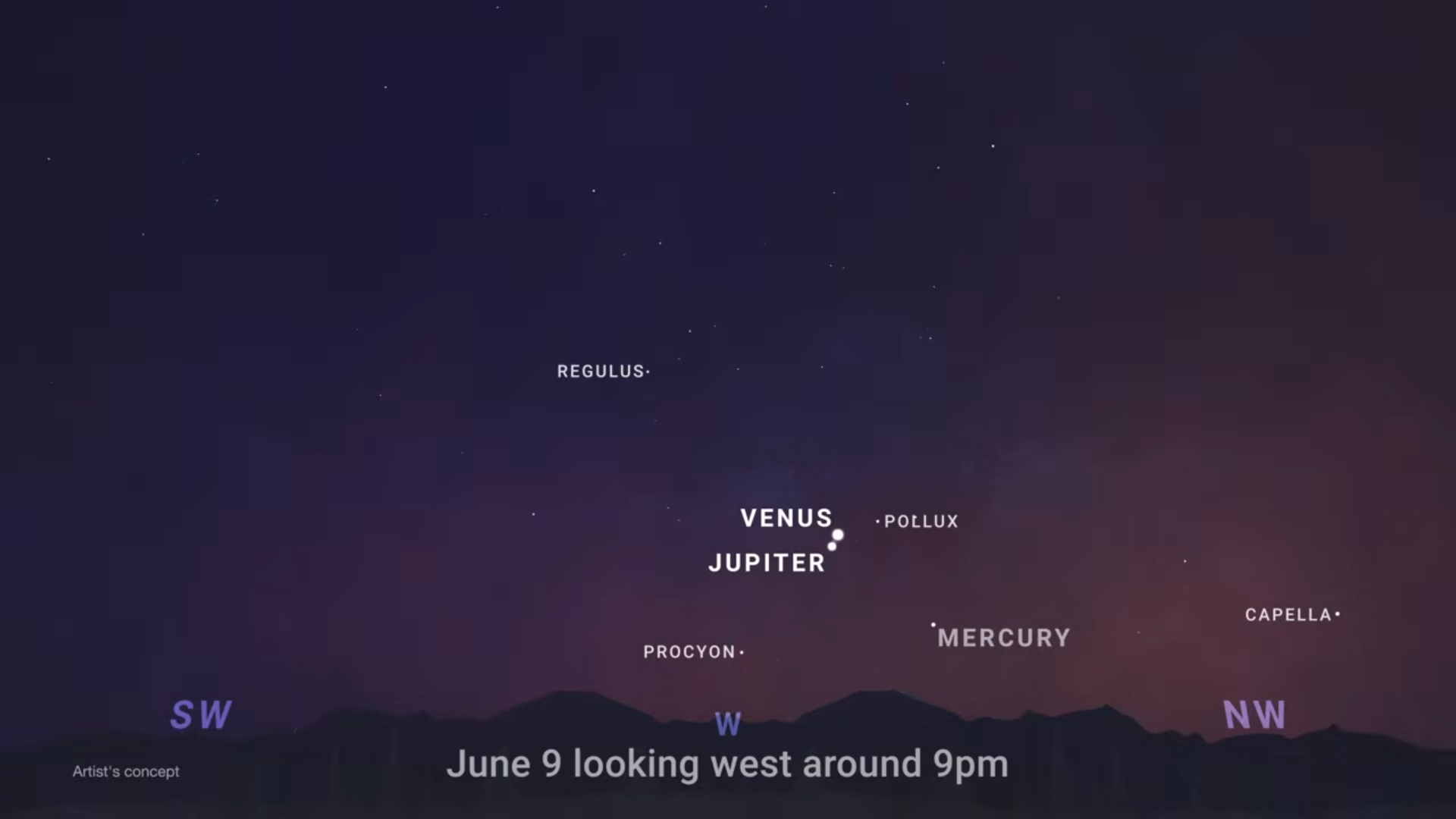
Venus will be the brighter of the two, making it easy to locate. Jupiter sits nearby. Look west shortly after sunset for the best view. No telescope required.
Mercury Joins the Lineup June 11-15
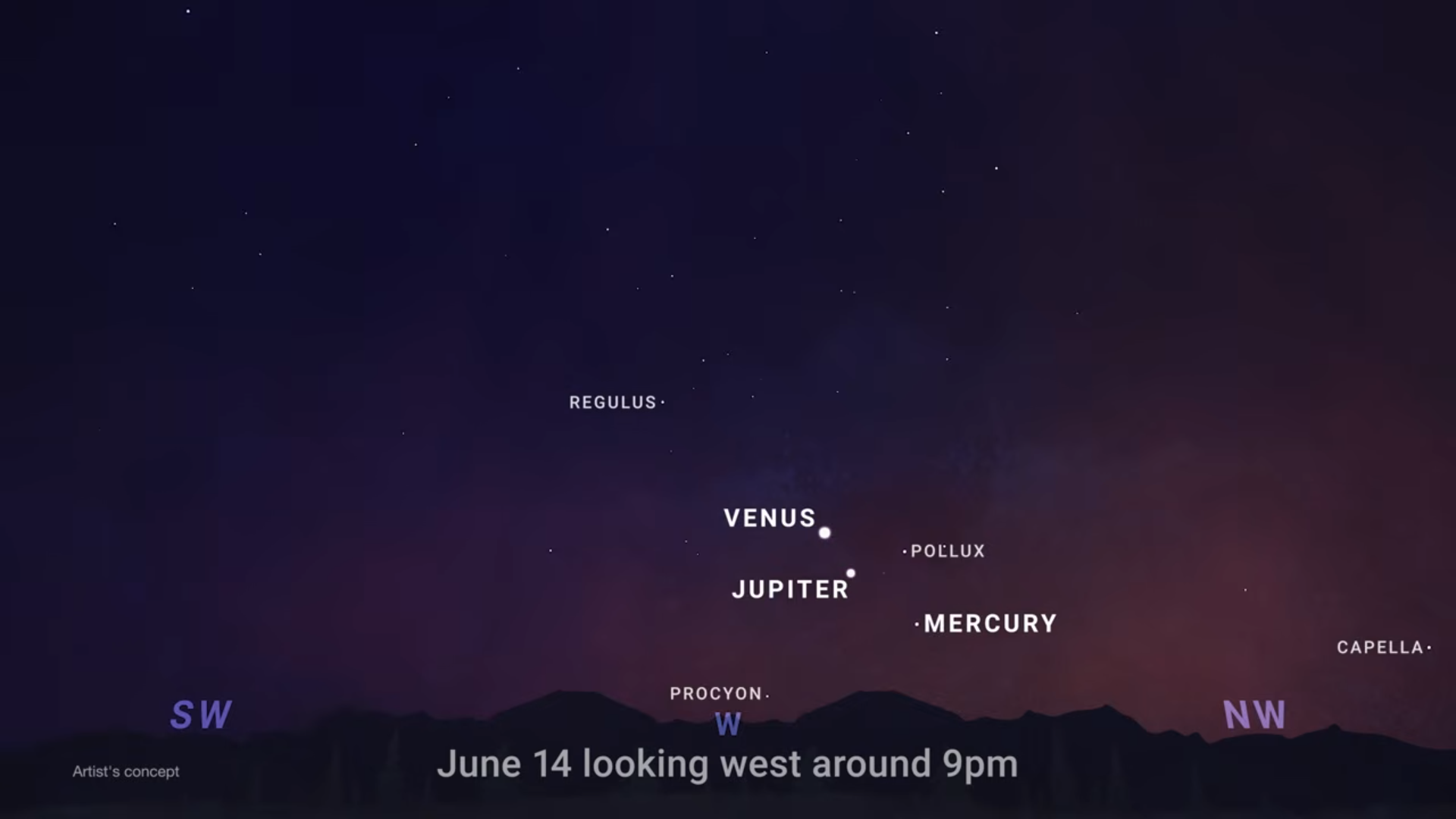
From June 11 through June 15, Mercury enters the frame. The three planets will form a compact grouping low in the western sky after sunset.
Mercury is the trickiest to spot. It sits lower toward the horizon and appears fainter than its neighbors. You will need a clear view to the west and minimal light pollution. Catching it in the glow of twilight takes patience, but binoculars help.
Lunar Occultation of Venus on June 17
The most dramatic event of the month happens on June 17, when the Moon will pass directly in front of Venus. This phenomenon is called a lunar occultation.
For viewers in the right locations, Venus will appear to disappear behind the Moon, then reappear on the other side. NASA says the event will be visible from parts of the United States, Canada, Brazil, and Venezuela. Those outside the exact viewing path may still see a close pairing of the Moon and Venus.
“The gathering of planets after sunset, with the Moon passing in front of Venus, offers a spectacular visual alignment for amateur astronomers across the Northern Hemisphere.”
— Raquel Villanueva, Science Communicator at NASA
NASA issued a safety warning for this event. For many viewers, the occultation will occur during daytime. If you attempt to observe it, do not point binoculars, a telescope, or a camera near the sun without proper solar safety equipment. Looking at or near the sun through optics can cause serious eye injury.
June Solstice Marks Start of Summer
The June solstice arrives on June 21 at 08:25 UTC. In the Northern Hemisphere, this marks the official start of astronomical summer and the longest day of the year.
Around the solstice, the Northern Hemisphere receives its maximum daylight hours. But here is a quirk of orbital mechanics: the longest day does not align exactly with the earliest sunrise or latest sunset. In Los Angeles, for example, the earliest sunrise comes before the solstice while the latest sunset comes after.
Summer Triangle Rises into View
Once the sky darkens, summer brings the return of a favorite asterism: the Summer Triangle. Formed by the bright stars Vega, Deneb, and Altair, this grouping rises in the eastern sky during evening hours throughout June.
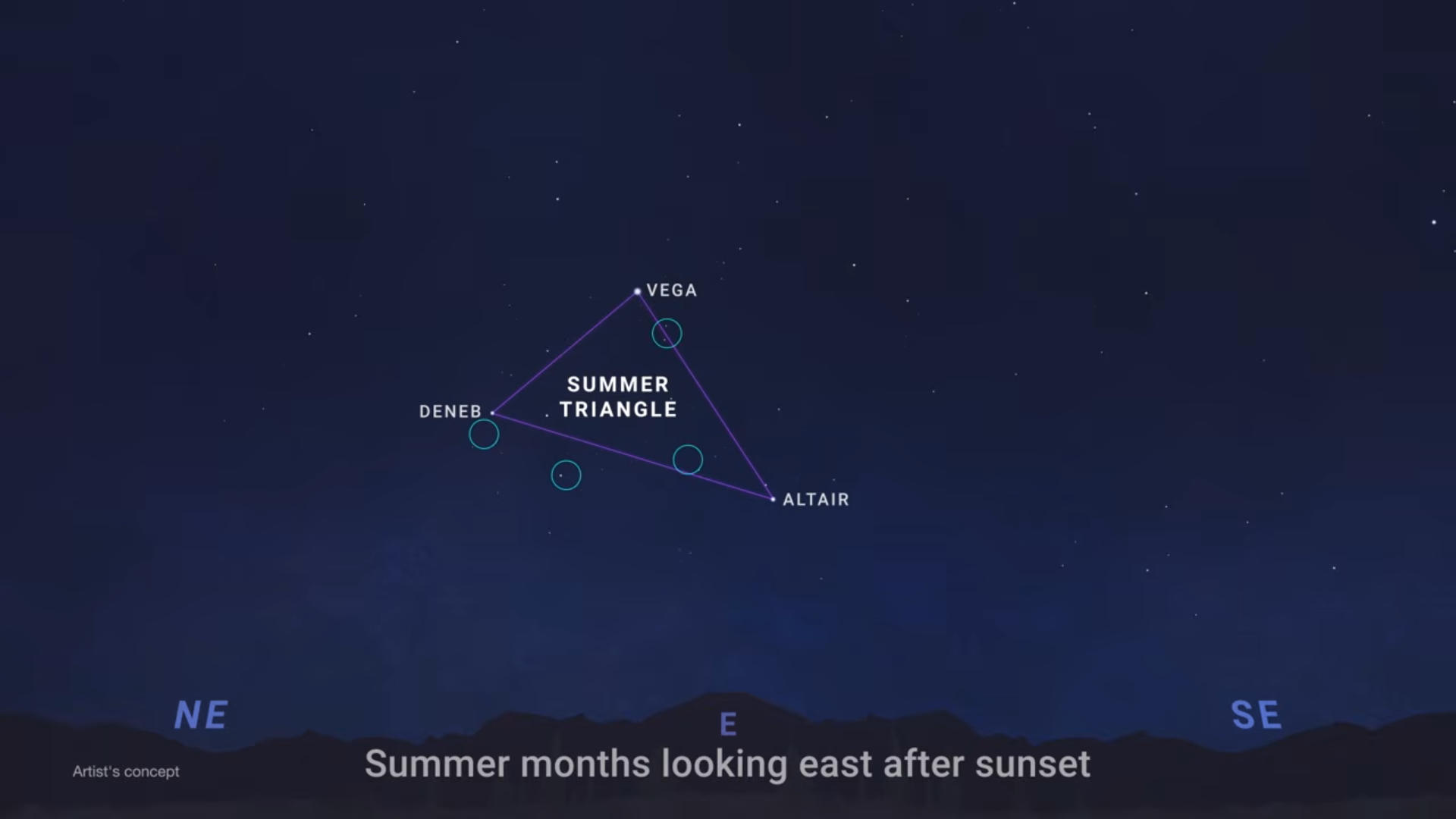
The Summer Triangle serves as a useful navigational landmark. Within and around it lie several deep-sky targets accessible with binoculars or small telescopes.
How to Watch
- For the Venus-Jupiter conjunction and planetary parade, look west 20-30 minutes after sunset
- Binoculars help for Mercury, which sits low on the horizon
- For the lunar occultation, check local timing resources for your specific location
- Do not use unfiltered optics to observe any event near the sun
- For deep-sky observing, wait until at least an hour after sunset when the sky fully darkens
Logicity's Take
Frequently Asked Questions
What time should I look for the Venus-Jupiter conjunction?
Look west 20-30 minutes after sunset on June 9. Both planets will be visible to the naked eye, with Venus appearing brighter.
Where can I see the lunar occultation of Venus on June 17?
The occultation will be visible from parts of the United States, Canada, Brazil, and Venezuela. Outside these areas, observers may still see a close Moon-Venus pairing.
Do I need a telescope to see the June 2026 planetary alignment?
No. Venus and Jupiter are bright enough to see with the naked eye. Binoculars help for spotting Mercury, which appears lower and fainter.
When is the June 2026 solstice?
The June solstice occurs on June 21, 2026 at 08:25 UTC, marking the start of astronomical summer in the Northern Hemisphere.
Need Help Implementing This?
Source: NASA
Manaal Khan
Tech & Innovation Writer
اقرأ أيضاً

رأي مغاير: كيف يؤثر اختراق الأمن الداخلي الأميركي على شركاتنا الخاصة؟
في ظل اختراق عقود الأمن الداخلي الأميركي مع شركات خاصة، نناقش تأثير هذا الاختراق على مستقبل الأمن السيبراني. نستعرض الإحصاءات الموثوقة ونناقش كيف يمكن للشركات الخاصة أن تتعامل مع هذا التهديد. استمتع بقراءة هذا التحليل العميق

الإنسان في زمن ما بعد الوجود البشري: نحو نظام للتعايش بين الإنسان والروبوت - Centre for Arab Unity Studies
في هذا المقال، سنناقش كيف يمكن للبشر والروبوتات التعايش في نظام متكامل. سنستعرض التحديات والحلول المحتملة التي تضعها شركات مثل جوجل وأمازون. كما سنلقي نظرة على التوقعات المستقبلية وفقًا لتقرير ماكنزي

إطلاق ناسا لمهمة مأهولة إلى القمر: خطوة تاريخية نحو استكشاف الفضاء
تعتبر المهمة الجديدة خطوة هامة نحو استكشاف الفضاء وتطوير التكنولوجيا. سوف تشمل المهمة إرسال رواد فضاء إلى سطح القمر لconducting تجارب علمية. ستسهم هذه المهمة في تطوير فهمنا للفضاء وتحسين التكنولوجيا المستخدمة في استكشاف الفضاء.