India Releases 5 of 20 Foundational AI Models Under IndiaAI Mission
Key Takeaways
- 20 foundational AI models built under IndiaAI Mission, 5 now released to the public
- Varya generates video at Rs 0.48 per second by reducing steps from 50 to 4
- Government subsidizes access to over 38,000 GPUs for AI research
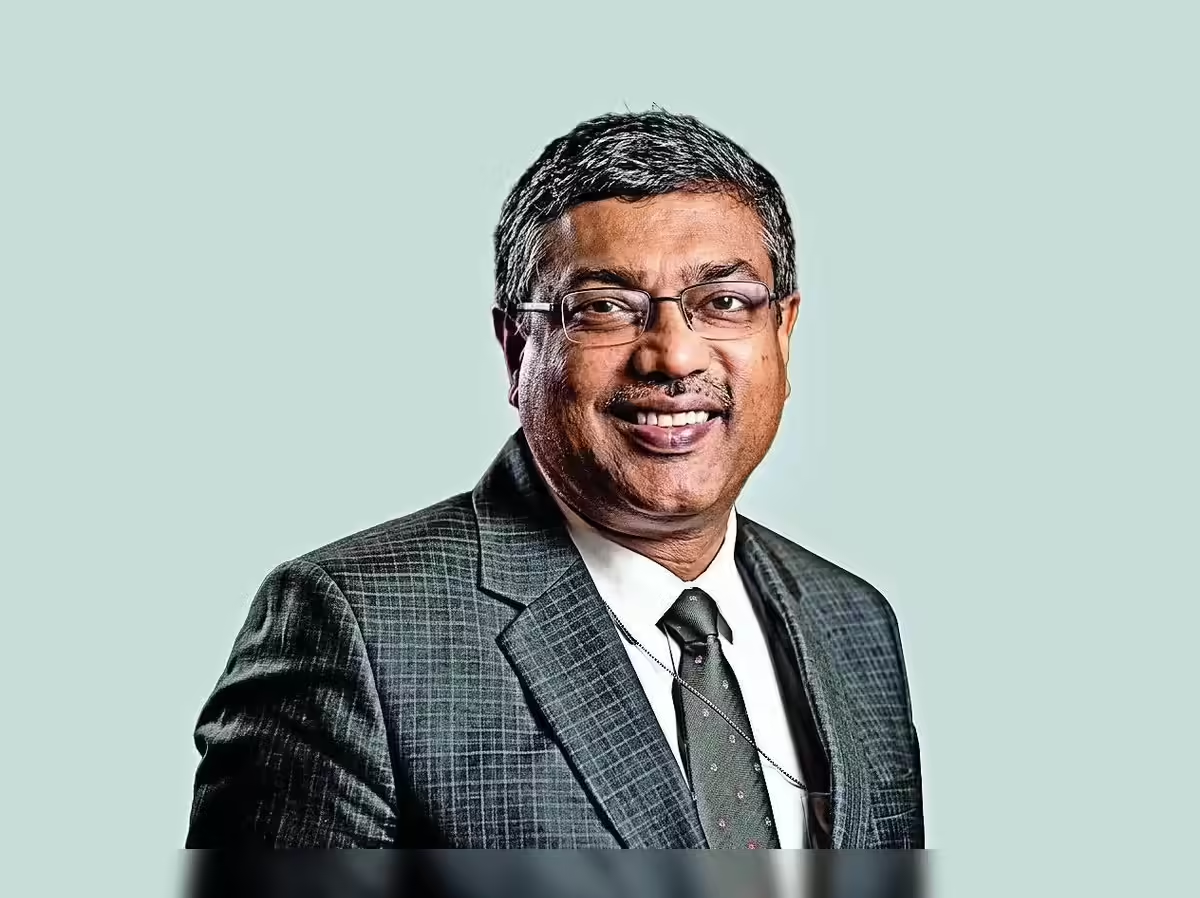
India's government-backed AI initiative has quietly built a substantial foundation. MeitY Secretary S. Krishnan announced Friday that startups supported by the IndiaAI Mission have created 20 foundational artificial intelligence models. Five of these are now publicly available.
The announcement came during the launch of Varya, a video-generation model built by Bangalore-based startup Avataar AI. It's the first homegrown "distilled" video model, a technical approach that dramatically cuts the cost and speed of AI video creation.
What Distillation Actually Does
Distilled video generation works like an apprenticeship for AI. A smaller "student" model learns to replicate the outputs of a larger "teacher" model while stripping away redundant computation. The result: similar quality videos generated much faster with less computing power.
That Rs 0.48 per second figure matters. Global AI video tools often cost several dollars per minute of generated content. Varya's economics could make AI video accessible to Indian businesses that previously couldn't justify the expense.
“In the future, where AI and robotics will come together, robots will have cameras, but they will need vision AI that can understand the world.”
— Sravanth Aluru, CEO and cofounder, Avataar AI
Aluru emphasized that Varya is entirely made in India. The compute infrastructure, the engineering team, the training data. It's not a fine-tuned version of an American model. It's a ground-up build.
The Other Released Models
Varya isn't alone. The five released models include work from both academic consortia and private startups.
- BharatGen: A multimodal large language model from IIT Bombay's academic consortium. It integrates text, speech, and image understanding across 22 Indian languages.
- Sarvam's 105-billion parameter model: A startup-built LLM focused on Indian language processing.
- Additional models targeting numeric computation, scientific research, and medical diagnostics.
The remaining 15 models are still in development. MeitY hasn't provided a timeline for their release.
How the Government Is Funding This
The IndiaAI Mission isn't just writing checks. It's building infrastructure that individual startups couldn't afford alone.
The program subsidizes access to over 38,000 graphics processing units. GPUs are the critical hardware for training AI models, and their scarcity has been a bottleneck for AI development globally. By pooling access, India lets smaller teams train models that would otherwise require Big Tech budgets.
The government also funds research consortia, groups of universities and labs working together on shared problems. And it supports a cohort of selected technology organizations with direct grants.
Understanding why generic AI models struggle with Indian languages
The Sovereignty Argument
Krishnan framed the initiative around a specific goal: keeping Indian data and experiences within Indian systems.
When Indians use ChatGPT or Gemini, their queries flow to American servers. Those interactions train models owned by American companies. The resulting AI understands American contexts better than Indian ones.
Homegrown models reverse that dynamic. They're trained on Indian languages, Indian use cases, Indian data. As they become more prevalent, Krishnan argued, India's data and experiences will be shared and used more widely within the country rather than exported.
This isn't just philosophical. An AI that understands Hindi idioms, Tamil medical terminology, or Marathi agricultural practices is genuinely more useful for Indian businesses than one optimized for English speakers in California.
What's Still Missing
Five released models is a start, not a finish. The released models cover language, video, and some scientific applications. But 15 models remain unreleased, and MeitY hasn't detailed what they'll address or when they'll arrive.
Indian tech communities are watching for models that tackle specific regional challenges. Healthcare diagnostics for diseases prevalent in India. Agricultural tools that understand local crop cycles. Financial models trained on Indian market patterns.
Whether the remaining 15 models address these gaps will determine whether IndiaAI Mission becomes infrastructure or just a press release.
Logicity's Take
Frequently Asked Questions
What is the IndiaAI Mission?
A government initiative to build sovereign AI capabilities in India by funding startups, subsidizing GPU access, and supporting research consortia to create foundational AI models.
How many AI models has India developed under this program?
20 foundational AI models have been created, with 5 now publicly released including Varya, BharatGen, and Sarvam's 105-billion parameter model.
What is distilled video generation?
A machine learning technique where a smaller AI model learns to replicate outputs of a larger model while eliminating redundant computation, producing similar results faster and cheaper.
How much does Varya cost to generate video?
Varya generates video at Rs 0.48 per second by reducing computational steps from 50 to 4.
How many languages does BharatGen support?
BharatGen is a multimodal LLM designed to integrate text, speech, and image understanding across 22 Indian languages.
Need Help Implementing This?
Source: Tech-Economic Times / ET
Huma Shazia
Senior AI & Tech Writer
اقرأ أيضاً

رأي مغاير: كيف يؤثر اختراق الأمن الداخلي الأميركي على شركاتنا الخاصة؟
في ظل اختراق عقود الأمن الداخلي الأميركي مع شركات خاصة، نناقش تأثير هذا الاختراق على مستقبل الأمن السيبراني. نستعرض الإحصاءات الموثوقة ونناقش كيف يمكن للشركات الخاصة أن تتعامل مع هذا التهديد. استمتع بقراءة هذا التحليل العميق

الإنسان في زمن ما بعد الوجود البشري: نحو نظام للتعايش بين الإنسان والروبوت - Centre for Arab Unity Studies
في هذا المقال، سنناقش كيف يمكن للبشر والروبوتات التعايش في نظام متكامل. سنستعرض التحديات والحلول المحتملة التي تضعها شركات مثل جوجل وأمازون. كما سنلقي نظرة على التوقعات المستقبلية وفقًا لتقرير ماكنزي

إطلاق ناسا لمهمة مأهولة إلى القمر: خطوة تاريخية نحو استكشاف الفضاء
تعتبر المهمة الجديدة خطوة هامة نحو استكشاف الفضاء وتطوير التكنولوجيا. سوف تشمل المهمة إرسال رواد فضاء إلى سطح القمر لconducting تجارب علمية. ستسهم هذه المهمة في تطوير فهمنا للفضاء وتحسين التكنولوجيا المستخدمة في استكشاف الفضاء.