Claude vs Gemini: Context Window Size Isn't What Matters
Key Takeaways
- Claude outperformed Gemini on a 150-page document test due to better source fidelity, not larger context window
- Both models now support over 1 million tokens, making raw capacity a non-differentiator
- The real bottleneck is reasoning accuracy across complex, interconnected documents
The Test That Exposed a Common Misconception
When comparing AI chatbots like Claude and Gemini, most users focus on context window size. It's the headline spec. Both Anthropic and Google tout windows exceeding 1 million tokens. But a real-world test with a 150-page document reveals that raw capacity isn't what separates these tools.
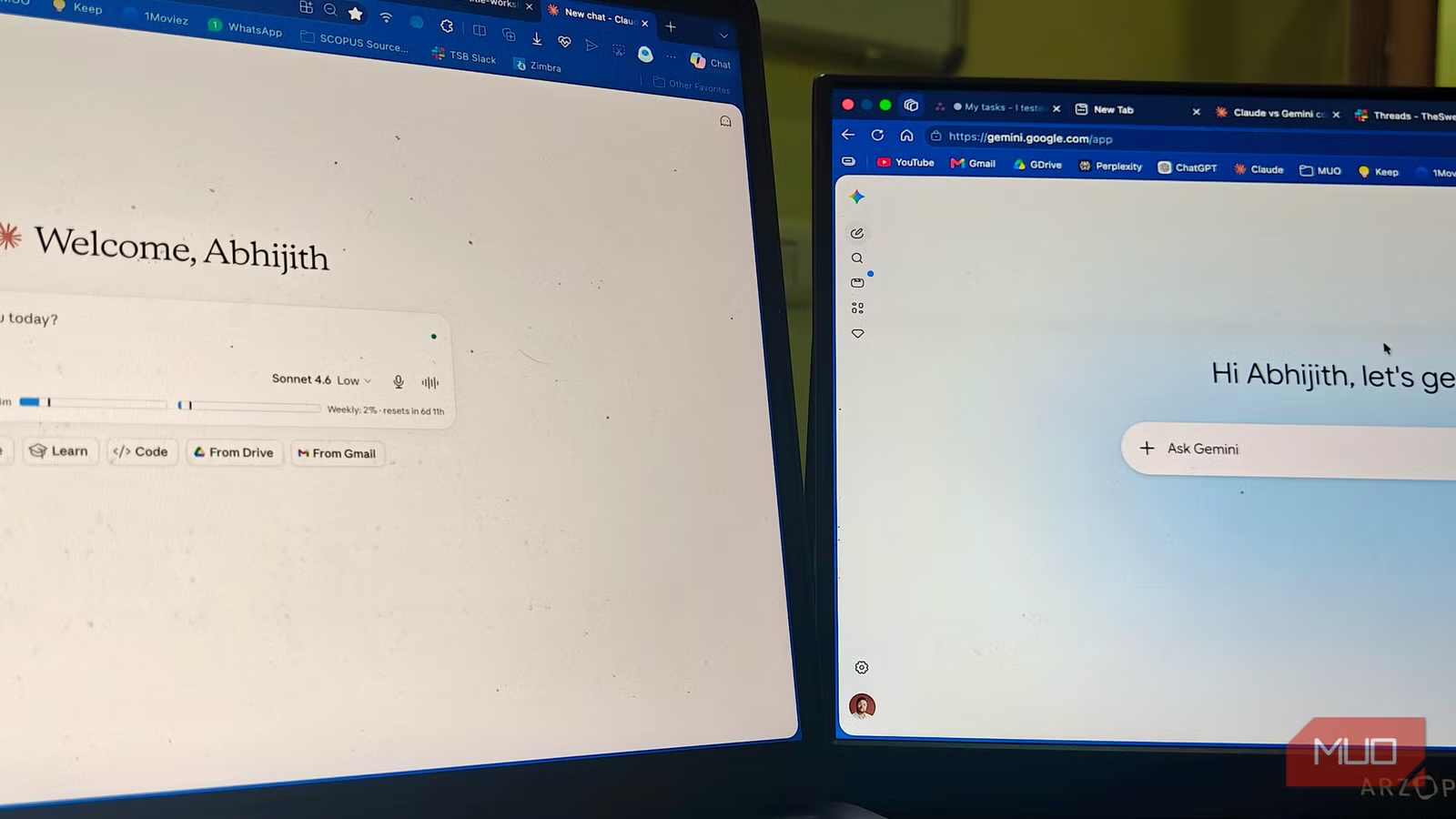
Tech writer Abhijith N Arjunan ran a structured comparison using identical prompts on both platforms. His goal was practical: figure out which AI delivers consistent, accurate answers when analyzing dense academic and technical documents. The answer surprised him. Claude won, but not because it could hold more text.
Why Source Fidelity Beats Raw Capacity
The test used a complex document that required more than simple summarization. Arjunan needed the AI to track intra-textual references, maintain consistency across sections, and avoid hallucinations. When responses from Claude and Gemini diverged significantly on the same prompts, the pattern became clear.
“The bottleneck isn't the amount of text a model can hold; it's the model's ability to maintain high fidelity to the source when the document exceeds human-readable length.”
— Dr. Sarah Chen, Lead Research Scientist at the AI Foundation
Claude consistently delivered answers that tracked back to specific sections of the source document. Gemini's performance degraded when asked to synthesize connections across the full 150 pages. The tokens were there. The reasoning wasn't.
The Numbers Behind the Comparison
Both models have impressive benchmark scores, but they excel in different areas. Claude 4.8 currently scores 88.6% on the SWE-bench Verified coding benchmark, indicating strong reasoning in technical contexts. Gemini 3.1 Pro leads with 94.3% on the GPQA benchmark, showing superior breadth in knowledge-based reasoning.
These benchmarks matter, but they don't capture what happens when you throw a 150-page PDF at each model and ask it to find specific connections. That's a different skill entirely.
“We are shifting from an era of 'how many pages can you read' to 'how accurately can you reason across the entire document's architecture'.”
— Julian Rivers, Lead Analyst at TechInsite
How the Test Was Structured
Arjunan didn't want to tilt the comparison. He used the exact same prompts on both platforms, submitting a document that wasn't a simple narrative. The 150-page file contained complex, interconnected information that required each AI to track multiple threads simultaneously.
He regularly uses AI tools for research tasks like summarizing chapters and finding intra-textual references. While NotebookLM excels at source fidelity, it's not practical for every query. Claude and Gemini became his go-to options. The confusion arose when their answers differed significantly on identical prompts with large attachments.
For work where hallucinations are unacceptable, knowing which model to trust became essential.
What the Community Says
This test aligns with broader user sentiment. On subreddits like r/ClaudeAI and r/GeminiAI, users report preferring Claude for deep-work tasks. Legal analysis, coding, and academic research are frequently cited use cases where Claude's output feels "less robotic" and "more accurate."
Gemini defenders point to different strengths. The model integrates tightly with Google Workspace, making it practical for users already in that ecosystem. It also handles multi-modal processing (video and audio) faster than Claude.
The takeaway isn't that one model is universally better. It's that the right choice depends on the task. For long-document analysis requiring source fidelity, Claude currently has the edge.
A contrasting perspective on when AI tools aren't the answer
Practical Implications for Long-Document Work
If you're analyzing contracts, research papers, or technical documentation, context window size is no longer the deciding factor. Both Claude and Gemini can hold over 1 million tokens. That's roughly 750,000 words. Most documents you'll ever work with fit inside either window.
The real question is: can the model reason accurately across that entire context? Can it track references from page 12 when answering a question about page 140? Can it avoid inventing information when the document doesn't explicitly state something?
Claude's performance on this test suggests it handles these challenges better. But Gemini's ecosystem integration and multi-modal speed make it preferable for other workflows.
| Feature | Claude 4.8 | Gemini 3.1 Pro |
|---|---|---|
| Context Window | 1M+ tokens | 1M+ tokens |
| Source Fidelity (Long Docs) | Strong | Degrades on complex synthesis |
| SWE-bench Score | 88.6% | Not primary benchmark |
| GPQA Score | Not primary benchmark | 94.3% |
| Ecosystem Integration | Standalone | Google Workspace |
| Multi-modal Speed | Standard | Faster |
The Shift in AI Evaluation
This comparison signals a broader shift in how we should evaluate AI tools. For years, context window size was the marquee feature. Bigger was better. Now that both leading models exceed 1 million tokens, that metric has become a baseline rather than a differentiator.
The next frontier is reasoning quality across that entire context. How well does the model maintain coherence? How accurately does it cite its sources? How reliably does it avoid hallucinations when the answer requires synthesizing information from multiple sections?
These questions are harder to benchmark than raw capacity. But they're what actually determine whether an AI tool is useful for serious work.
Logicity's Take
Frequently Asked Questions
Does Claude have a larger context window than Gemini?
No. Both Claude 4.8 and Gemini 3.1 Pro support context windows exceeding 1 million tokens. The difference lies in reasoning accuracy across that context, not raw capacity.
Which AI is better for analyzing long documents?
Claude currently shows stronger source fidelity when working with complex, multi-section documents. Gemini's performance tends to degrade when synthesizing connections across very long contexts.
Is context window size still important when choosing an AI tool?
Context window size has become a baseline feature. Both leading models exceed 1 million tokens. The more important factors are reasoning precision, hallucination rates, and ecosystem integration.
When should I use Gemini instead of Claude?
Gemini excels at multi-modal processing (video and audio) and integrates tightly with Google Workspace. If you're already in that ecosystem or need fast multi-modal analysis, Gemini may be the better choice.
How can I test AI source fidelity on my own documents?
Submit the same complex document and prompts to both models. Ask questions that require synthesizing information from multiple sections, then verify the answers against your source. Track which model cites specific sections accurately.
Need Help Implementing This?
Source: MakeUseOf
Huma Shazia
Senior AI & Tech Writer
اقرأ أيضاً

رأي مغاير: كيف يؤثر اختراق الأمن الداخلي الأميركي على شركاتنا الخاصة؟
في ظل اختراق عقود الأمن الداخلي الأميركي مع شركات خاصة، نناقش تأثير هذا الاختراق على مستقبل الأمن السيبراني. نستعرض الإحصاءات الموثوقة ونناقش كيف يمكن للشركات الخاصة أن تتعامل مع هذا التهديد. استمتع بقراءة هذا التحليل العميق

الإنسان في زمن ما بعد الوجود البشري: نحو نظام للتعايش بين الإنسان والروبوت - Centre for Arab Unity Studies
في هذا المقال، سنناقش كيف يمكن للبشر والروبوتات التعايش في نظام متكامل. سنستعرض التحديات والحلول المحتملة التي تضعها شركات مثل جوجل وأمازون. كما سنلقي نظرة على التوقعات المستقبلية وفقًا لتقرير ماكنزي

إطلاق ناسا لمهمة مأهولة إلى القمر: خطوة تاريخية نحو استكشاف الفضاء
تعتبر المهمة الجديدة خطوة هامة نحو استكشاف الفضاء وتطوير التكنولوجيا. سوف تشمل المهمة إرسال رواد فضاء إلى سطح القمر لconducting تجارب علمية. ستسهم هذه المهمة في تطوير فهمنا للفضاء وتحسين التكنولوجيا المستخدمة في استكشاف الفضاء.