Astrobotic Griffin-1 lunar lander targets late 2026 launch
Key Takeaways
- Griffin-1 is the largest commercial lunar lander built to date, with 625 kg payload capacity
- NASA designated the mission Moon Base II, part of establishing permanent lunar infrastructure
- The lander carries 10 payloads from six nations and will launch on a SpaceX Falcon Heavy in late 2026
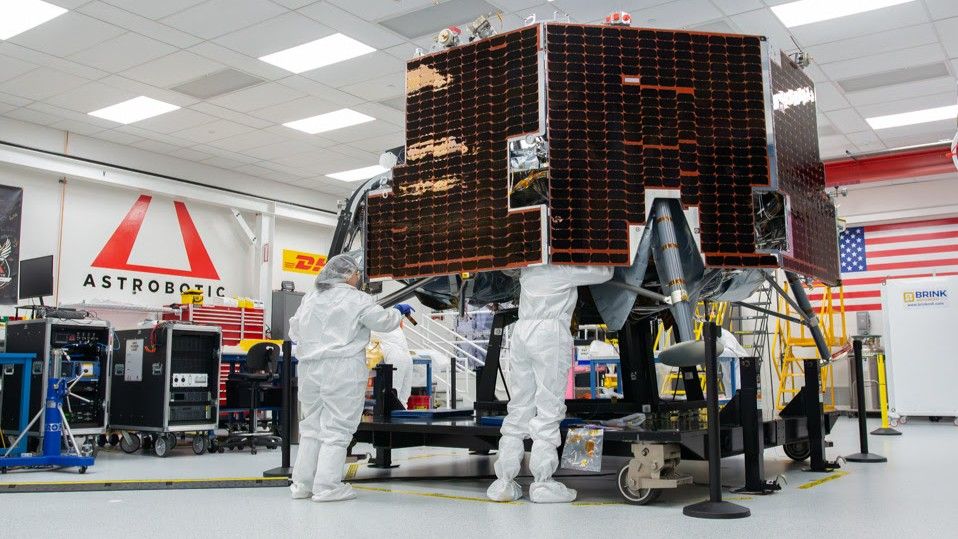
Astrobotic revealed its Griffin-1 lunar lander on June 15, the largest commercial vehicle ever built to land on the Moon. NASA has designated the mission Moon Base II, signaling a shift from scientific experiments to delivering infrastructure for a permanent lunar outpost. The Pittsburgh company is targeting late 2026 for launch aboard a SpaceX Falcon Heavy.
The lander can haul 625 kilograms to the lunar surface at a cost of $1.2 million per kilogram. That capacity dwarfs previous commercial attempts and positions Griffin as the workhorse for NASA's long-term Artemis plans.
What makes Griffin-1 different from Peregrine?
Griffin-1 is Astrobotic's second lunar attempt. The company's smaller Peregrine lander launched in January 2024 but suffered a propellant leak shortly after separation and never reached the Moon. That failure, the first NASA Commercial Lunar Payload Services (CLPS) flight, put pressure on Astrobotic to prove its hardware.
Griffin is a different animal. Both landers stand about 2 meters tall, but Griffin spans nearly 4.5 meters across, almost twice Peregrine's width. The extra real estate accommodates heavier payloads and, according to community discussions on HackerNews and Reddit, incorporates dual-redundant valve systems to prevent the propellant leak that doomed Peregrine.
“This is the first infrastructure-class lander going to the surface of the moon. This lander will be part of the cornerstone of building the moon base on the surface of the moon.”
— John Thornton, CEO of Astrobotic
What payloads will Griffin-1 carry?
Griffin-1 will deliver 10 payloads from six countries. The headline cargo is the FLEX rover from California's Astrolab, a modular vehicle designed to support long-duration operations rather than short science campaigns. Four additional NASA payloads ride aboard FLEX itself.
Other payloads include Astrobotic's own BEACON CubeRover, developed with Mission Control Space Services, and the European Space Agency's LandCam-X, which will gather data to improve landing precision on future missions.
The manifest also carries some unusual items. A plaque from Japan's Nippon Travel Agency contains messages from children. The Galactic Library to Preserve Humanity from Nanofiche stores miniaturized literature and art. Tokyo-based Astrobotic's MoonBox capsule holds micro SD cards with submissions from around the world.
What's the timeline to launch?
Integration at Astrobotic's Pittsburgh headquarters wraps up this week. The lander ships to NASA's Jet Propulsion Laboratory in California next week for environmental testing. After that, Griffin-1 moves to Florida, where Astrolab will integrate the FLEX rover before the Falcon Heavy launch in late 2026.
How does Griffin fit into NASA's Artemis program?
NASA's CLPS program outsources lunar deliveries to commercial partners so the agency can focus resources on astronaut missions and deep-space vehicles. The arrangement mirrors how NASA buys cargo flights to the International Space Station from SpaceX and Northrop Grumman.
Griffin-1's Moon Base II designation marks a pivot. Earlier CLPS flights were science experiments. Moon Base II is infrastructure. The payloads are designed to stay, support follow-on missions, and eventually service human crews. Thornton described Griffin as "the cornerstone" of building a lunar base.
Astrobotic's acquisition by Voyager Technologies has sparked debate about vertical integration in lunar logistics. Some observers argue the merger creates a full-stack model where Voyager controls launch booking, lander operations, and surface mobility. Others worry about concentration in a market NASA hoped would stay competitive.
Can Astrobotic recover from Peregrine's failure?
Peregrine's propellant leak was a public embarrassment, but it did not end Astrobotic's relationship with NASA. The agency extended contracts and kept Griffin on the manifest. That vote of confidence reflects NASA's broader bet on commercial lunar services: accept some failures early to build a competitive market later.
Still, Griffin-1 has to work. Another failure would raise serious questions about Astrobotic's engineering and Voyager's oversight. The dual-redundant valve system and extended ground testing at JPL are direct responses to Peregrine's flaws. Whether those fixes hold will determine if Astrobotic becomes a serious lunar logistics provider or a cautionary tale.
Logicity's Take
Griffin-1 is a credibility test disguised as a cargo mission. Astrobotic's Peregrine failure forced the company to prove it can execute, not just win contracts. The real story here is not the payload manifest but the dual-redundant plumbing. If Griffin lands safely, Astrobotic becomes the commercial backbone of Artemis. If it fails, NASA's entire CLPS strategy faces uncomfortable scrutiny.
Frequently Asked Questions
When will Griffin-1 launch to the Moon?
Astrobotic is targeting late 2026 for a SpaceX Falcon Heavy launch from Florida.
How much payload can Griffin-1 carry?
Griffin-1 can deliver up to 625 kilograms to the lunar surface at a cost of $1.2 million per kilogram.
What happened to Astrobotic's first lunar lander?
The Peregrine lander launched in January 2024 but experienced a propellant leak shortly after deployment and never reached the Moon.
What is NASA's Moon Base II mission?
Moon Base II is NASA's designation for Griffin-1, part of the first phase of establishing permanent lunar infrastructure under the Artemis program.
What rover will Griffin-1 deliver to the Moon?
Griffin-1 will carry the FLEX rover from Astrolab, designed for modular, long-duration lunar surface operations.
Need Help Implementing This?
If you're a company exploring space logistics contracts or building hardware for lunar missions, Logicity covers the commercial space sector in depth. Subscribe to our newsletter for weekly updates on NASA partnerships, launch schedules, and emerging opportunities in cislunar commerce.
Source: Latest from Space.com
Huma Shazia
Senior AI & Tech Writer
اقرأ أيضاً

رأي مغاير: كيف يؤثر اختراق الأمن الداخلي الأميركي على شركاتنا الخاصة؟
في ظل اختراق عقود الأمن الداخلي الأميركي مع شركات خاصة، نناقش تأثير هذا الاختراق على مستقبل الأمن السيبراني. نستعرض الإحصاءات الموثوقة ونناقش كيف يمكن للشركات الخاصة أن تتعامل مع هذا التهديد. استمتع بقراءة هذا التحليل العميق

الإنسان في زمن ما بعد الوجود البشري: نحو نظام للتعايش بين الإنسان والروبوت - Centre for Arab Unity Studies
في هذا المقال، سنناقش كيف يمكن للبشر والروبوتات التعايش في نظام متكامل. سنستعرض التحديات والحلول المحتملة التي تضعها شركات مثل جوجل وأمازون. كما سنلقي نظرة على التوقعات المستقبلية وفقًا لتقرير ماكنزي

إطلاق ناسا لمهمة مأهولة إلى القمر: خطوة تاريخية نحو استكشاف الفضاء
تعتبر المهمة الجديدة خطوة هامة نحو استكشاف الفضاء وتطوير التكنولوجيا. سوف تشمل المهمة إرسال رواد فضاء إلى سطح القمر لconducting تجارب علمية. ستسهم هذه المهمة في تطوير فهمنا للفضاء وتحسين التكنولوجيا المستخدمة في استكشاف الفضاء.