Anthropic Board Adds Novartis CEO Vas Narasimhan: What This Means for AI Safety and Healthcare
Key Takeaways
- Vas Narasimhan becomes first major pharma CEO on a leading AI company's board
- Trust-appointed directors now hold majority control at Anthropic
- Narasimhan has overseen 35+ novel drug approvals at Novartis
- The move signals AI companies are borrowing governance models from regulated industries
- Anthropic's Long-Term Benefit Trust structure is designed to prioritize safety over speed
Read in Short
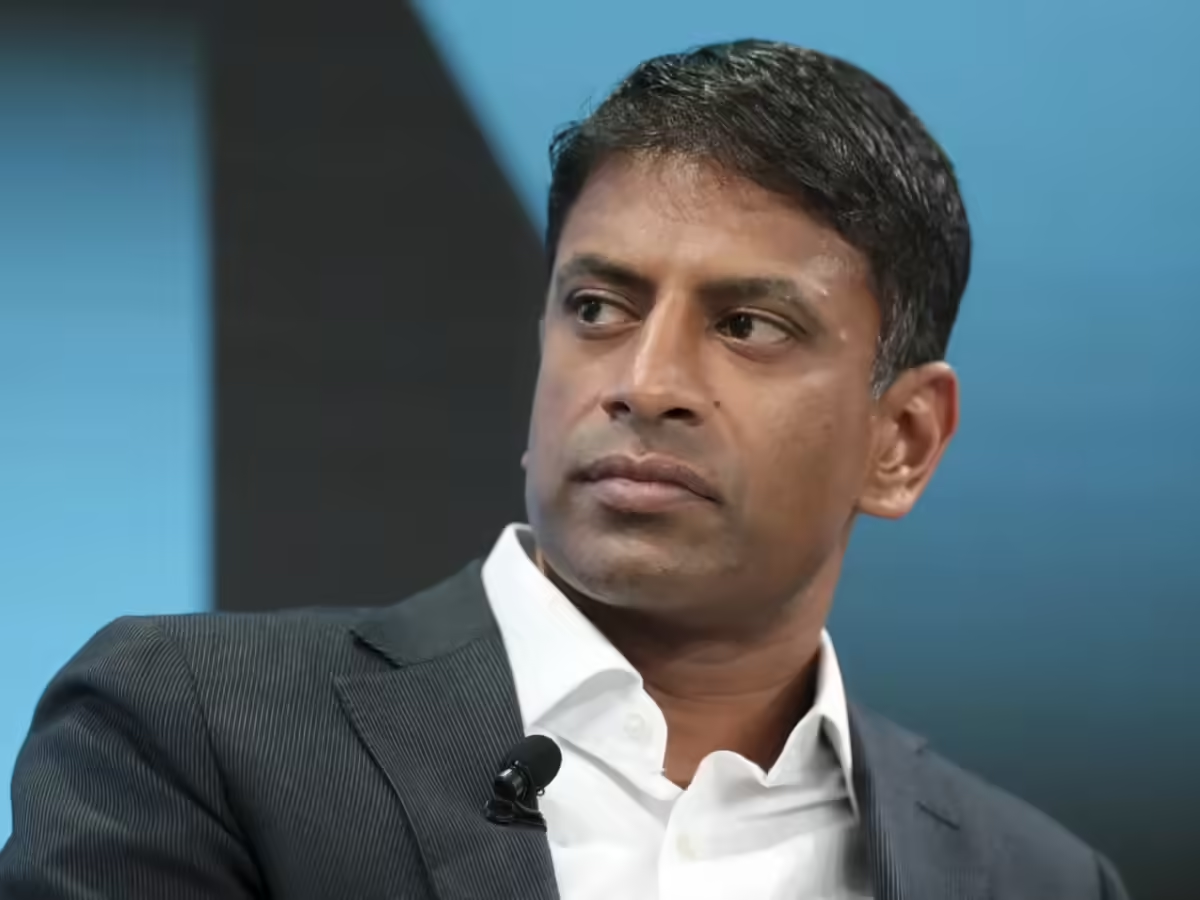
Novartis CEO Vas Narasimhan just joined Anthropic's board, making him one of the most prominent pharma executives to take a governance role at an AI company. With Trust-appointed directors now holding majority control, Anthropic is doubling down on its 'safety first' approach by bringing in someone who literally knows how to get complex, high-stakes technology approved and deployed responsibly.
So here's the thing about AI companies right now. They're all racing to build the most powerful models, but very few are thinking hard about what happens when these systems actually start making real decisions in the real world. Anthropic just made a move that suggests they're taking that question seriously.
The Claude maker announced that Vas Narasimhan, the CEO of pharmaceutical giant Novartis, is joining its board of directors. And this isn't just some honorary position. Narasimhan's appointment was made by Anthropic's Long-Term Benefit Trust, an independent governance body that now controls a majority of board seats.
Why a Pharma CEO on an AI Board Actually Makes Sense
At first glance, putting a drug company executive on an AI company's board might seem random. But think about it for a second. Pharmaceutical companies have spent decades figuring out how to take incredibly powerful, potentially dangerous technology and get it to people safely. They deal with regulators constantly. They run massive clinical trials. They think in terms of risk profiles and adverse events.
That's exactly the kind of institutional knowledge AI companies need right now. Anthropic cofounder and president Daniela Amodei put it pretty directly in the announcement.
“Vas brings something rare to our board. He has spent his career doing what we are trying to do with AI, taking powerful, complex technology and getting it to people safely at scale.”
— Daniela Amodei, Cofounder and President of Anthropic
The kicker? Narasimhan isn't just some suit who signs off on earnings reports. Before running Novartis, he did public health work on HIV/AIDS, malaria, and tuberculosis programs across India, Africa, and South America. The guy has actually been in the field working on global health challenges. He's seen what happens when complex medical interventions meet messy real-world conditions.
The Long-Term Benefit Trust Power Shift
Here's why this appointment matters beyond the individual. With Narasimhan joining, directors appointed by Anthropic's Long-Term Benefit Trust now hold a majority on the board. That's a big deal structurally.
What is Anthropic's Long-Term Benefit Trust?
Anthropic set itself up as a public-benefit corporation with an unusual governance structure. The Long-Term Benefit Trust is an independent body designed to make decisions that prioritize long-term safety and societal benefit over short-term business pressures. It can appoint board members and has the power to influence key company decisions, especially as Anthropic scales its most advanced AI systems.
Most tech companies have boards dominated by investors and founders who are, let's be honest, primarily focused on growth and returns. Anthropic's structure explicitly tries to balance that. Neil Shah, who chairs the Trust, said Narasimhan's appointment reflects their intent to bring "long-term scientific and ethical stewardship into core decision-making."
Translation: they want adults in the room who've actually dealt with life-and-death technology decisions before.
The Impressive Resume Behind the Appointment
Narasimhan's credentials read like someone was specifically designing the perfect candidate for this role. He's a member of the US National Academy of Medicine. He sits on the Council on Foreign Relations. He serves on academic boards at both the University of Chicago and Harvard Medical School. He previously chaired PhRMA, the main trade association for pharmaceutical research companies.
- CEO of Novartis, one of the world's largest pharmaceutical companies
- Overseen 35+ novel drug approvals through complex regulatory processes
- Former public health work on HIV/AIDS, malaria, and TB across three continents
- Member of US National Academy of Medicine
- Council on Foreign Relations member
- Academic board positions at University of Chicago and Harvard Medical School
- Former chair of Pharmaceutical Research and Manufacturers of America (PhRMA)
He joins a board that already includes some heavy hitters. Dario and Daniela Amodei (the cofounders), Reed Hastings (Netflix cofounder), Jay Kreps (Confluent CEO), Yasmin Razavi, and Chris Liddell. But Narasimhan brings something none of them have: deep experience in getting complex technology through regulatory gauntlets.
If you're interested in how AI is being integrated into everyday tools, this piece on Google's new Chrome AI features shows the consumer side of the AI deployment equation.
AI Meets Healthcare: The Bigger Picture
Narasimhan himself commented on why this crossover makes sense right now. AI isn't just some abstract technology for healthcare anymore. It's already changing how drugs get discovered and how biomedical research happens.
“In healthcare, AI is accelerating solutions to some of the hardest scientific challenges.”
— Vas Narasimhan, CEO of Novartis
And he's right. We're seeing AI models help identify drug candidates, predict protein structures, and analyze medical imaging. The question isn't whether AI will transform healthcare. It's whether that transformation happens safely or chaotically.
This is where Anthropic's approach gets interesting. Daniela Amodei noted that Narasimhan's experience with highly regulated pharmaceutical systems aligns perfectly with what they're trying to do. They talk about "deployment discipline" and "controlled release of advanced models." That's pharma language applied to AI.
A Trend Worth Watching
Anthropic isn't alone in reaching outside the tech bubble for governance help. The announcement notes that AI companies are increasingly recruiting domain experts from regulated industries like healthcare, finance, and defense. And that makes sense. These frontier models are getting close to real-world scientific and clinical applications.
You can't just move fast and break things when you're building AI that might help diagnose diseases or discover new drugs. The stakes are too high. Someone who's spent their career in pharma understands that viscerally in a way that even the smartest AI researcher might not.
Why Regulated Industry Experience Matters for AI
Pharmaceutical companies operate under some of the strictest regulatory frameworks in the world. Getting a drug approved requires years of clinical trials, mountains of documentation, and constant regulatory oversight. That institutional muscle memory for safety, documentation, and controlled deployment is exactly what AI companies need as their models become more powerful and more widely deployed.
What This Signals About Anthropic's Direction
Look, AI companies say a lot about safety. It's become almost a marketing talking point at this stage. But governance structures are where you actually see what companies prioritize.
Anthropic putting Trust-appointed directors in the majority, and specifically recruiting someone like Narasimhan, suggests they're serious about building institutional safeguards. They're not just hiring safety researchers. They're embedding safety-focused governance at the board level.
Is it enough? That's a fair question. But compared to the governance structures at most AI companies, this is genuinely different. And bringing in someone who's navigated FDA approvals for 35 drugs isn't just symbolic. It's practical. Narasimhan knows what compliance frameworks look like, what documentation you need, and how to build organizations that can handle intense regulatory scrutiny.
The Bottom Line
This appointment won't make headlines like a new model launch or a billion-dollar funding round. But it might matter more in the long run. As AI systems get more powerful and start touching more sensitive areas like healthcare, the companies that figure out responsible deployment will have a massive advantage.
Anthropic is betting that bringing pharma expertise into its governance will help them get there. With Vas Narasimhan on the board, they've got someone who's actually done this before, just with molecules instead of models.
And honestly? That's the kind of thinking the AI industry needs more of right now.
Source: Tech-Economic Times / ET
Huma Shazia
Senior AI & Tech Writer
اقرأ أيضاً

رأي مغاير: كيف يؤثر اختراق الأمن الداخلي الأميركي على شركاتنا الخاصة؟
في ظل اختراق عقود الأمن الداخلي الأميركي مع شركات خاصة، نناقش تأثير هذا الاختراق على مستقبل الأمن السيبراني. نستعرض الإحصاءات الموثوقة ونناقش كيف يمكن للشركات الخاصة أن تتعامل مع هذا التهديد. استمتع بقراءة هذا التحليل العميق

الإنسان في زمن ما بعد الوجود البشري: نحو نظام للتعايش بين الإنسان والروبوت - Centre for Arab Unity Studies
في هذا المقال، سنناقش كيف يمكن للبشر والروبوتات التعايش في نظام متكامل. سنستعرض التحديات والحلول المحتملة التي تضعها شركات مثل جوجل وأمازون. كما سنلقي نظرة على التوقعات المستقبلية وفقًا لتقرير ماكنزي

إطلاق ناسا لمهمة مأهولة إلى القمر: خطوة تاريخية نحو استكشاف الفضاء
تعتبر المهمة الجديدة خطوة هامة نحو استكشاف الفضاء وتطوير التكنولوجيا. سوف تشمل المهمة إرسال رواد فضاء إلى سطح القمر لconducting تجارب علمية. ستسهم هذه المهمة في تطوير فهمنا للفضاء وتحسين التكنولوجيا المستخدمة في استكشاف الفضاء.